In the North African region that lies across the sea, Spain has two enclaves: Melilla and Ceuta. These areas border Morocco but are part of the European Union.
In June 2022, a tragic incident occurred in Melilia where thousands of African immigrants attempted to breach the border fences, resulting in numerous casualties. This became one of the most controversial immigration tragedies in European external borders history. Four years later, at the end of July, more than 70,000 illegal immigrants flooded into Hudna, causing 88 deaths. This not only created a humanitarian crisis but also quickly turned into a European political storm.
In early July, the Spanish Supreme Court ruled that illegal immigrants who enter the enclaves by land will be deported on the spot. However, those who arrive by sea cannot be expelled without proper legal review and must go through the entire judicial process. This legal interpretation was later misinterpreted as a highly inflammatory slogan: “As long as one swims to Huelva, they can stay.” The Moroccan Ministry of Interior attributed this incident mainly to false information on social media, the instigation of human trafficking gangs, and the wrong interpretation of Spanish laws.
However, what really deserves attention in this crisis is no longer just the single event itself, but many other aspects.
Why has Europe invested huge amounts of money in controlling its borders, even extending immigration control to North Africa, yet still cannot prevent similar tragedies from happening again? By entrusting its borders to North African countries, is this “outsourcing” actually making Europe more dependent on, and even subject to, these “gatekeepers”? Why has the number of illegal immigrants entering Europe decreased in recent years, but deaths, conflicts, and political divisions remain unchanged?
Over the past decade or so, Europe has been continuously building higher and higher border walls, as well as extending its borders outward into Europe. However, it has proven that the wave of immigration has not disappeared as a result. It has simply changed routes, locations, and appears in a more dangerous form.
From Morocco to Spain, from North Africa to Europe, from border security to domestic politics, Europe is facing an increasingly difficult dilemma: it attempts to solve the immigration problem by building walls, but it gradually realizes that what really needs to be addressed is not just how to prevent immigrants from entering, but whether Europe is losing control over its immigration policies.

July 30, 2026, the Spanish North African enclave of Ceuta saw a large influx of undocumented migrants arriving by sea from Morocco. IC Photo
Huda and Melilla's uniqueness lies in the fact that they are not ordinary European borders. These two cities are located on the African continent, yet they belong to Spain. They are also the only land territories of the EU on the African continent.
From a European perspective, it is an important entry point into the EU. However, geographically speaking, it is also surrounded by Morocco.
This particularity has made Spain face a long-term challenge: Europe wants to control the southern borders, but Europe’s borders lie in Africa.
Since 2010, a large number of refugees from Africa, the Middle East, and South Asia have reached Europe through the Mediterranean and Balkan Peninsula. The peak of the refugee crisis occurred in 2015.
Over the past decade or so, the EU has gradually developed a new model for managing immigration. Instead of relying solely on border checks within Europe, it has extended its defense lines southward. It has cooperated with North African countries such as Morocco, Tunisia, and Mauritania, asking these countries to help Europe prevent illegal immigrants from reaching European coasts.
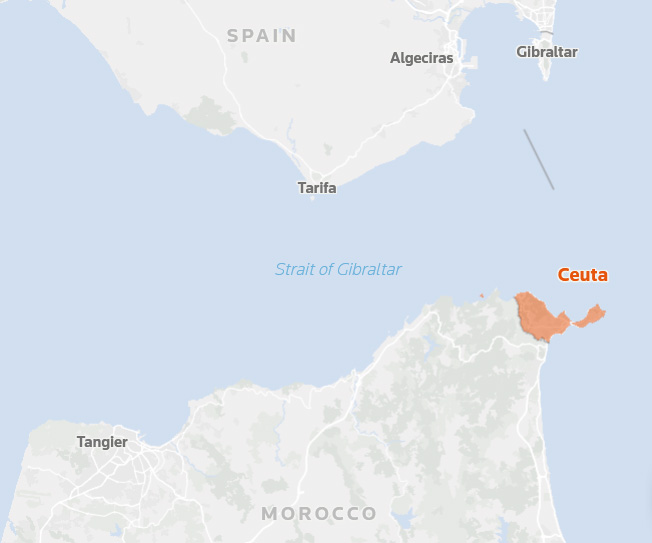
Huada is a Spanish enclave in North Africa. Image.
British "Financial Times" and other European media have long been concerned about this trend, believing that the EU is increasingly relying on third countries for what is called "border externalization".
"Financial Times" European Edition Senior Editor Ben Hall on August 2nd, in a commentary article, pointed out that this model did indeed reduce the number of immigrants entering Europe to some degree. However, at the same time, a new problem emerged: when Europe needs North African countries' help to maintain its borders, North African countries have also gained an important bargaining chip for Europe.
In 2021, a similar crisis occurred in Juha.
At that time, during the diplomatic disputes over the disputed territory of Western Sahara between Spain and Morocco (which was under Moroccan control), thousands of illegal immigrants broke through the border controls of Ceuta. Subsequently, Spain changed its stance, supporting Morocco's proposal to establish autonomy over the region under its sovereignty.
During this Huda crisis, when Spain and its European allies attacked each other, Madrid carefully avoided blaming Rabat. The article states that in the short term, Spain needs Morocco's cooperation to receive immigrants from Huda; in the long term, Morocco needs to provide cooperation in immigration control and security matters.
This reminds us that the EU’s immigration control relies on cooperation with neighboring countries. But given reports indicating a lack of regular personnel at the Moroccan border, Madrid has every reason to believe that Rabat allowed immigrants to enter in order to pressure Spain. Why? Because Morocco has done this before.
Obviously, the article’s author Hol directly “questioned” Morocco.
Of course, without direct evidence, it cannot be simply assumed that Morocco 'created' this crisis in Hodeisa. However, one fact is becoming increasingly clear: after outsourcing border management to North African countries in Europe, there must also be a reality that needs to be faced—the security of Europe's borders depends largely on how the North African countries choose to act.
On July 31, a commentary article by the American think tank German Marshall Foundation also stated that Europe's overreaction to immigration issues, as well as its obsession with outsourcing immigration control to third countries, has given those countries a very easy leverage for exerting pressure. Ultimately, illegal immigrants have become political tools and face deadly risks.
If we only look at the numbers, Europe seems to be achieving results. In recent years, the overall number of illegal immigrants entering the EU has been declining.
EU-related data shows that the number of arrivals along some major migration routes has significantly decreased. However, according to data cited by the Spanish newspaper El País in January this year, based on figures from the European Border Management Agency (Frontex), the risk remains.
According to Frontex, the number of illegal immigrants entering the EU in 2025 was approximately 178,000, a decrease of 26% compared to previous years. This is the lowest level since 2021. However, although the number of illegal arrivals on all routes has significantly decreased, the number of people smuggled along the Western Mediterranean route, from Algeria to the Spanish coast, increased by 14%.
The International Organization of Migration (IOM) estimates that approximately 1,878 people died at sea last year. If these statistics are reliable, then one in every 100 persons who arrived at the coast has died.
Therefore, the real problem lies in that immigration pressure has not disappeared, it has just shifted direction.

June 13, 2026, Rome, Italy - National demonstration organized by the Immigration Repatriation and Recapture Committee in Rome. The event calls for the passage and implementation of an immigration repatriation law. IC Photo
European immigration policies in the past have increasingly focused on preventing people from reaching Europe. These measures include strengthening border facilities, expanding maritime interceptions, cooperating with third countries to prevent departures, and accelerating deportation procedures.
Although these measures have reduced the number of people entering Europe, they have not eliminated the reasons that drive population migration. In recent years, war, poverty, employment pressure, and political instability still exist. As the IOM has long pointed out, these turbulent factors contribute to migration. Simply strengthening border controls cannot eliminate these deep-seated causes.
Therefore, as reported by the Spanish newspaper El Día on August 2nd, the immigration wave is not a temporary phenomenon. History shows that blocking one entry point does not solve the crisis; instead, it simply shifts the immigration flow to other routes. When one route is blocked, another may become available.
Morocco has intensified its control measures, with some pressure possibly shifting to the Canary Islands; risks in the Western Mediterranean are increasing, and other maritime routes may become active again; Europe has strengthened its external borders, and smuggling networks are constantly seeking new vulnerabilities.
More importantly, the stricter border controls may lead some immigrants to take more dangerous methods: swimming across the strait, riding dangerous boats across the Atlantic, or using human trafficking networks to find new routes...
Europe has addressed the issue of "entry management," but it has not solved the problem of "migration pressure." The number of people arriving in Europe has decreased, but the danger has not diminished. In fact, deaths may have been shifted to more hidden and harder-to-track places.
Therefore, there is a paradox here. It’s difficult to say whether Europe has “failed in success” or “successed in failure”.
If in the past the issue of European immigration was mainly a matter of border management, then today it has become an important political conflict within Europe.
After the crisis at HSD, European countries' reactions once again exposed the divisions within the EU.
Spain hopes to gain more European support, believing that immigration pressure should not be borne by a few border countries. However, some countries are primarily concerned with how to prevent such pressure from spreading to their own regions.
According to the Financial Times, after the tragedy, Italian Right-wing Prime Minister Meloni immediately called for a suspension of Spain’s Schengen Area membership. Similarly strong on immigration issues, Danish Centre-left leader Rasmus Jensen and several other EU leaders also responded to Meloni’s call in varying degrees.
And faced with fierce accusations and warnings from other EU countries, Spanish Prime Minister Sánchez, was also criticized by other EU members for their responses to the crisis. He called the actions "selfish, divisive, and illegal."
These all indicate that the issue of immigration is no longer just a matter between Europe and the outside world, but it is also affecting relations within the European Union.
In the past few years, the issue of immigration has also been an important factor driving the rise of European right-wing political parties.
From France and Germany, to the Netherlands and Italy, an increasing number of political forces are making immigration a central issue in elections.
For example, the Italian Prime Minister Meloni, leading the Brothers of Italy party, as well as two female politicians from the far-right in France, Le Pen and Wei Dell's respective French National Union party and Germany's Choice Party, are all prioritizing reducing illegal immigration and strengthening border control as key political stances.

From left to right: Wei De'er, Lerong, Melo Ni Datasheet
The immigration wave is changing Europe's politics.
In a sense, Europe’s immigration policy is trapped in a cycle: in order to control immigrants, Europe strengthens its borders; in order to strengthen borders, Europe relies more and more on third countries; relying on third countries brings new diplomatic risks; the long-standing unresolved immigration issue further drives European politics to the right.
The tragedy that occurred in Huda at the end of July 2026 is not an isolated event.
From Melilla to Ceuta, from the Mediterranean to the Atlantic Ocean, from North Africa to the European continent – this is actually a complete chain.
Europe wants to build a higher border wall to resist the wave of immigration. However, it will eventually discover that this high wall is riddled with holes, and beneath it lie the bones of many more people.
The disappearance of 72 lives may once again remind Europe that the high wall built over the past decade and a half has not only created a boundary, but also led to a series of unavoidable deaths.
How to prevent tragedies from happening again? European policymakers still have no solution...
