Located on the coast of the South Atlantic Ocean, Angola is one of the few regions where the United States is willing to compete with China for influence in Africa.
Despite the U.S. government re-focusing on leveraging the Lubu Corridor to secure key mineral resources, it has been proven that China's leading position in African infrastructure development is unshakable.
Based in the United States, Eric Orland, an analyst and editor at the non-profit research organization 'China-Global South Project', told the Hong Kong-based South China Morning Post on August 4 that Chinese companies have gained advantages on the African continent, and it is unlikely that the United States will respond to China's latest projects in Angola.
Last month, Huatong Angola, a local subsidiary of China's Huatong Group, signed a $900 million deal with SBDD, a company engaged in the development of new port facilities in Baladudande, located approximately 600 kilometers (373 miles) north of Port Loitoto.
SDBD Board Chairman Roque Saraiva said in an interview with Angolan News Agency that both parties signed two documents: one is about the exclusive right to operate the port terminal, with an investment of approximately US$450 million; and the other is about infrastructure, with a total investment of US$900 million.
The franchise period is 25 years, and it can be extended based on business results and feasibility.
According to Salaiva, the upgrading project of the Baladudand port terminal is divided into three phases. Phase one will be completed in 24 months, and phases two and three are expected to be finished between 2029 and 2030. By then, the terminal will be fully built.
He said that after the completion of the first phase of the project, the dock will be put into operation, ensuring the export of various industrial products from the free trade zone. After the project is completed, it will be able to accommodate ships with a load capacity of 80,000 tons. It is expected that after full operation, the annual trade volume will exceed $10 billion.
Zhang Wendong, Chairman of Huatong Angola Industrial Co., Ltd., said that once the project is completed, the Baladudand Port Terminal will greatly improve the regional transportation system, revitalize coastal resources, enhance logistics capabilities, and drive industrial development. It will significantly enhance the strategic position of this infrastructure in Southern Africa.
The South China Morning Post pointed out that this further expands China's leading position in infrastructure investment in Africa, while the United States is currently trying to catch up with China's influence in Africa.
This port is part of the Baladudand Integrated Development Free Trade Zone. This export-oriented project aims to create a hub for manufacturing, exports, and logistics in the northern part of Luanda, the capital of Angola. The project will achieve this goal by transforming remote areas along the Atlantic coast.
This is a large-scale project that Chinese enterprises frequently carry out in various African locations with low costs. It is also an achievement that Western peers cannot match.
Orland said that Chinese companies have already taken advantage of this factor to gain an edge on the African continent, and it is unlikely that the United States will respond to China’s latest projects in Angola.
"The US does not have the ability to conduct projects at low costs, like Chinese companies, and has been successful in this area for many years. Olandell says: 'The US government's African policy focuses primarily on security and ensuring a reliable supply of raw materials, that's all.'"
Angola was the only African country visited by former U.S. President Biden during his tenure.
During this visit, just before the end of his term, Biden explained the reasons for investing in the strategically important Lobito corridor. This railway connects Angola's Lobito port with neighboring countries the Democratic Republic of the Congo and Zambia, providing the United States with a route that it believes allows access to key mineral supplies from these two countries.
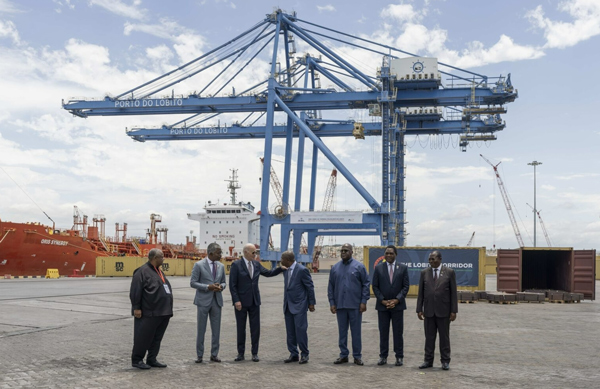
During Biden’s only visit to Africa during his presidency, he visited the Lobito port. United States Embassy in China
To date, the United States has invested $553 million in this project through its International Development Finance Corporation. The main role of this institution is to curb China’s economic influence around the world.
The Biden administration views investments in Angola as part of promoting the U.S. energy transformation. This is because battery technology and electric vehicles require key mineral resources.
"Although this agreement was built upon the foundation laid by the Biden administration, its significance has become more pronounced under President Trump's leadership," said Alex Vennings, Director of European Foreign Relations Committee's African Projects.
This reflects a shift in foreign policy from climate-centered policies to more aggressive geopolitical policies that focus on critical mineral supply chains, regional trade integration, and grand power competition.
Even some American officials have discussed how to win Angola to join the United States’ camp by gaining its support from China. However, observers point out that this idea seems to ignore the deep relationships that already exist between the two countries.
In March 2024, China and Angola officially established a comprehensive strategic partnership.
O'Land said that, unlike China, the United States limits its interests in Africa to security and access to key resources.
"Of course, they don't like Chinese people, and they do not want to see Chinese people succeed in Angola, but they will not make any response to this statement." Orlando said.
Machan Zhi, an assistant researcher at the Development Studies Institute of the China Institute of International Studies, said that in the past two years, Angola has been very close to the United States. However, the only major economic investment by the US in Angola has been in the oil and natural gas industries. When the US energy production reached record levels, Angola's oil exports also suffered significantly. 'They talk of being partners, but in reality, they always consider their own interests.'
Ma Hanzhi said that every country wishes for export diversification, but when choosing partners, one must consider the long-term development of the country.

