Around July 30th, a large number of illegal immigrants flowed into the Spanish territory of Ceuta from Morocco, becoming one of the most serious immigration crises at the EU border in recent years.
According to Reuters, on August 2 local time, Perez Terianno, representative of the Spanish government in Ceuta, stated that large-scale illegal immigration crossings have resulted in at least 72 deaths.
This number is far higher than Morocco's authorities announced that "11 deaths" occurred earlier.
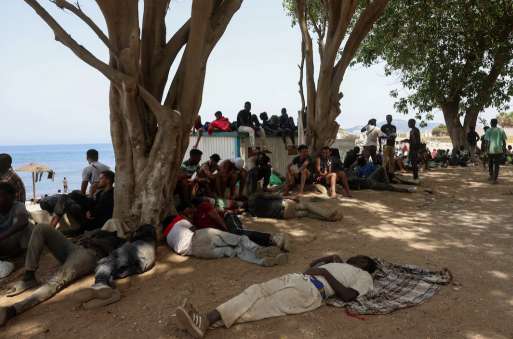
August 1st, immigrants rest in Huda. Reuters
According to reports, on August 2 local time, Triano told reporters that in addition to the 72 deceased, more than 1,000 people received medical care.
He stated that the situation in Huida has improved significantly, but more efforts are needed to restore normal conditions.
Al Jazeera reported on August 2, citing the AFP, that the number of deaths is expected to increase.
The Spanish Civil Guard has begun identifying the 72 bodies found. Carlos Atuchi, an officer from the Spanish Civil Guard’s forensic department, said that fingerprint collection and DNA sample gathering will be completed by the end of next weekend at the latest.
According to Reuters, some immigrants drowned, while others were crushed while trying to climb over breakwaters and border fences. Many people participated in the incident due to financial difficulties and inspired by rumors on social media.
On August 2nd, the Moroccan Interior Ministry stated in a statement that 11 people had died, most of whom drowned while trying to enter Spain. It also mentioned that they were verifying reports of deaths on the other side of the border.
The department attributed this incident to misinformation on social media, human trafficking networks, and misunderstandings of a Spanish ruling that prohibits the immediate repatriation of immigrants intercepted at sea.
Reuters pointed out that this is similar to the comments made by the Spanish Ministry of Foreign Affairs on this matter.
Moroccan authorities estimate the number of people crossing the border to be 40,000, which is much lower than the figure used by Spanish officials. They also noted that 1,135 people were prevented from entering another Spanish territory, Melilla.
Declaration: Morocco reiterates its commitment to combatting illegal immigration and calls for a shared burden in managing immigration.
It is reported that Huida has increased patrols by the police and military forces. On August 1st, the Spanish police installed a 500-meter-long floating barrier near Huida.
Leaders from 22 countries, including Italian Prime Minister Meroni and German Chancellor Merz, have jointly written a letter to the EU authorities. They expressed “serious concerns” regarding the large-scale cross-border movements in Huda, stating that these pose a threat to the EU borders. They also criticized Spain’s Prime Minister Sánchez for its relatively lax immigration policies—especially the large-scale legalization plans, which could become a “stumbling block.”
The letter calls for strengthened external border control and coordinated actions, and indicates a readiness to resume temporary border inspections in the Schengen Area. Italy took action first, temporarily restricting the free movement arrangements with Spain; countries like France have also increased border inspections.
According to reports, Spain has launched a program to grant residency rights to over 500,000 people without legal documents. The country denies any attempt to encourage illegal immigrants to move into Ceuta, stating that those who illegally enter the enclave are not allowed to travel further into Spain or other parts of the Schengen Area.
Spanish Foreign Minister Alvarez announced on the evening of July 31 that at least 50,000 immigrants who had arrived in Hodea have “almost completely” returned to Morocco.
Many immigrants told Reuters that hunger, exhaustion, and hostility from locals shattered their hopes of starting a new life in Europe.
Those who returned to Morocco said that they were initially attracted by viral social media videos and information from friends, which suggested that the border could be breached. However, upon arriving in Hegfa, many reported that they couldn’t find any way to continue their journey towards mainland Spain.
Immigrants returning from Morocco have repeatedly complained about the closure of supermarkets and shops in Huda, forcing them to search for food and water while drying their wet clothes on the streets.
A worker who works at the Mediterranean port of Dénia in Morocco said, “Huda is like a prison; there is nothing to do, everything is locked up.”
Some immigrants accuse residents of the community of Hudeil-Pringinspe to have attacked or driven them away, a community primarily made up of Moroccan descendants. Reuters reported that these claims could not be verified.
Moroccan waiter Yassine Ichou described himself as having been beaten and driven away from El Principe. "They carried out a siege to force us to leave Huda, and they succeeded," he said. He added that he was referring to the widespread closure of shops.
According to a Reuters report from August 1st, cafes have reopened in Huda, and customers are flooding in, making the city gradually regain its vitality. However, most stores remain closed, with patrol cars driving along the streets.
The hardware store owner Tito still hasn’t opened its doors. He said that the sudden influx of so many people frightened the locals, but he also felt sympathy. “You feel overwhelmed and helpless. Those young people have been completely exploited. They are used as bargaining chips.”
