During Trumps visit to China, China once again set a red line regarding the Taiwan issue for the US. After Trump returned to the United States, debates within the US about whether the US has made too many concessions to China have intensified. At the same time, the US Congresss decision to postpone further military sales to Taiwan has caused significant unease among Taiwanese authorities. Lai Ching-te, while reiterating the so-called democratic alliance and value partners, attempts to maintain the illusion of stable US-Taiwan relations through manipulative public relations efforts.
Does this meeting between Chinese and American leaders mean that China and the US are trying to establish a non-breaching barrier during their competition as major powers? Why is the Taiwan issue at the core of this barrier system? If the Trump administration shows signs of policy swings in the future, how should mainland China respond?
This episode of Cross-Strait Roundtable invited Gao Zhikai, a chair professor at Suzhou University and the deputy director of the Center for Global Governance (CCG), along with Lei Qian, a senior researcher at the Belt and Road Research Institute at Hainan University. They discussed these topics in depth.
After Trumps visit to China, international media have been discussing extensively the significant changes brought about by Sino-US interactions. Many analysts believe that these developments could have new implications for the situation along the Taiwan Strait. Within the United States itself, there are also voices expressing concerns, such as those who argue that Trump has made too many concessions in his dealings with China. Even within the Republican Party, there are dissenting opinions.
How does Teacher Lei view the political pressure that Trump will face after returning to his country? Will this pressure affect the continuity of his policies towards China in the future? Will there be difficulties in implementing the outcomes of this visit to China?
In fact, this meeting between Chinese and American leaders has set a great example for the entire world. It shows that the management of relations between major powers is actually very delicate. Upon closer examination, it becomes clear that Chinas signals to the outside world revolve around constructive strategic stability relations. Both sides agreed that there will be long-term, intense competition between them, but this competition must be conducted in a way that does not lead to destruction. Thus, a pattern of long-term, intense competition between major powers has been established. This historical achievement, written together by China and the United States, is now part of the global landscape. This was the most important topic discussed during Trumps visit to Beijing.
Of course, everyone has also noticed that, as I have mentioned on various occasions before, Trump has shown a rare degree of humility this time. Some may ask, isnt it expected for a guest to behave in such a manner when visiting other countries? But those who know Trump well understand that he never behaves like this when visiting any place. Behind this rare degree of humility lies the confidence that comes from Chinas strength.
However, the most important tail that was laid out before this interaction was the Taiwan issue. In Fox News first interview with Trump, right after he left the Chinese mainland, hints about this issue began to emerge. This is precisely the subtlety of interactions between major powers: certain matters are not discussed directly, nor presented through joint press conferences or statements. Instead, various signals are conveyed through different channels.
Some media in Taiwan initially seemed happy, claiming, Look, theres no mention of Taiwan at all. However, after a day or two, they were proven wrong. In fact, not only was Taiwan mentioned, but the issue of military sales to Taiwan was also discussed in great detail. In their testimony before the U.S. Congress, the U.S. side provided a reasonable excuse for temporarily suspending its planned military sales to Taiwan worth $14 billion. They claimed that they needed to take into account the situation in the Middle East and maintain their military strength. This is the second very detailed aspect of this situation.
Thirdly, as we can see, the United States sent a large delegation to participate in this event. However, unlike the delegation that attended Putins visit later on, the US side did not reach any concrete agreements with their counterparts. After returning to the United States, Steve Jobs even admitted that Chinas high-end chip market has been transferred to othersspecifically, Chinese domestic alternatives. These details highlight the gap between the superficial displays and the actual advantages held by each side, reflecting the delicate balance of power between the two nations.

On May 25, 2026, Huaweis board director and president of the Semiconductor Business Unit, He Tingbo, announced the Tau Law at the 2026 International Circuits and Systems Symposium. Xinhua News Agency
After Trump returned to the United States, many believed that he had made too many concessions. However, Trump did not respond to this situation with a too much attitude. In fact, he viewed this trip as a significant historical milestone, which aligns well with his self-proclaimed role as Trump the Great. Throughout history, figures like Alexander the Great and Julius Caesar were also referred to as the Great. By describing his visit to China as a very important historical turning point, Trump has indeed fulfilled his role as a great leader in history.
When Chinese national leaders mentioned not falling into the Thucydides Trap at the beginning of their conversation, a new chapter in Sino-US relations was officially begun. Both sides recognized the situation involving two major powersChina and the United States. They tried to establish some kind of barrier amidst long-term, intense competition. They also agreed on their respective core concerns regarding Taiwan, separatism, and matters related to the Taiwan Strait. I believe that there will be further developments in these areas in the future.
This is what I often refer to as the Three-Tier Section. It represents a crucial part of the guardrail between the two countries. If we compare Sino-US relations to a highway, then this section is precisely the Three-Tier Section – its the core of the entire guardrail system. On this issue, our position and reactions are quite clear. Meanwhile, the United States continues to use military sales as a means to send various signals to Taiwan region.
As for Taiwans reaction, some long-standing pro-independence groups have recognized and accepted the significant gap in strength between the two sides. Whether they are willing to do so or not, these groups have expressed their willingness to accept the future arrangements of cross-strait unification. If more and more groups are willing to acknowledge this power disparity and agree that cross-strait unification is beneficial for Taiwan, then opportunities like Dr. Li Jiaying from Hong Kongs Shenzhou 23 mission will become reality for Taiwanese people.
It has been noted that after Trumps visit to China, Teacher Gao gave a high rating of 9.99 out of 10. This was surprising to many people. The relevant content wasnt only seen by Trump himself; he also shared it on social media, which attracted international attention. I would like to ask Teacher Gao why you gave such a high rating. What signals does Trumps acceptance of this rating send in the context of Sino-US interactions?
Around 2 p.m. on May 15th, Trump left Zhongnanhai and headed to Capital International Airport, preparing to fly back to the United States on Air Force One. At this exact moment, at 2:12 p.m., I gave a live interview to CNN in the United States. When they asked me to rate President Trumps visit, I said that if a full score were 10 points, I would give him 9.99 points.
Importantly, I also mentioned that it was a significant event when the leaders of both countries visited the Temple of Heaven together. After all, the Temple of Heaven has always been a place where people prayed for harvests, peace, and stability. Additionally, I spoke about Biden, pointing out that he broke the tradition established since President Reagans time, when every U.S. president had visited China as a state visit. Biden did not make any such visits during his four-year presidency, thus he broke this tradition. I am very grateful to Trump for restoring this important tradition of U.S. presidents visiting China as state visits.
After that, the situation you mentioned earlier occurred. President Trump boarded Air Force One. About an hour later, he shared my interview with CNN. This is significant in itself, as it shows that he saw the interview. It seems he was quite satisfied with the 9.99-star rating I gave. Especially when I mentioned that President Biden was a Cold War president, he must have been delighted. For me, its like winning the Powerball lotteryPresident Trump personally shared my interview with him.

Trump shared an article from CNNs political channel titled 9.99 out of 10: Chinese scholars say this visit has put Sino-U.S. relations back on track.
However, I believe that there lies a profound truth behind this. After all, Trump conducted a three-day state visit to China. The Chinese side repeatedly emphasized the red line and explained to Trump Chinas strict stance on the Taiwan issue. This is crucial. Has Trump ever had the opportunity to hear such a serious and detailed explanation from the Chinese side before? Perhaps yes, but not like this before. This is the first point, which is extremely important.
Another point is that Trumps visit to China has shattered two strategies pursued by the United States: one was the so-called risk reduction, and the other was the attempt to detach from China. By bringing along 17 executives from large corporations during his visit, Trump clearly demonstrated that the idea of detachment no longer exists, as well as the lack of any efforts to reduce risks. This means that for the United States, it is now possible to continue doing business with China and both sides can benefit from it. This represents a politically correct approach. Therefore, Trumps visit to China can be considered a turning point, completely changing these situations.
Trump has always claimed that Biden failed to make America greater. Just now, Professor Lei also mentioned the Xunzi Trap. Regarding Professor Graham Allisons theory that the Xunzi Trap inevitably leads to World War I, I was opposed to this theory from the beginning. After careful research, I discovered a clear flaw in Professor Allisons theory: all the war cases he studied were based on conventional weapon-based wars. However, he implied or explicitly stated that this conclusion could apply to both China and the United States, two nuclear powers. He studied conventional weapon-based wars, but his theoretical conclusions should be applied to the situation between China and the United States, two nuclear powers. The idea of transcending the Xunzi Trap is certainly good and shows great courage. However, the default assumption behind this idea is that there exists a Xunzi Trap between China and the United States.
Therefore, I proposed the theory of inevitable peace between China and the United States. No matter what attitude the United States takes towards China, it must maintain peace with China. In my opinion, Trumps visit to China is a step in the right direction, sending a clear message that war between China and the United States should not occur.
Now, the United States can no longer defeat China using conventional weapons. It is impossible for the US to achieve a complete victory in such a conflict. Last year, some Americans claimed that the US nuclear weapons are more powerful than those of China. Indeed, China never discloses the exact number of its nuclear warheads. However, we have clearly stated our position: if the US dares to launch a nuclear war against China, China will have enough nuclear warheads to completely destroy the enemy. From this perspective, I believe that the US has already passed the stage where it can continue to confront China through military means and hope to achieve a complete victory.
I am particularly pleased to see that Trump was extremely polite during his visit to China. During those three days in Beijing, I dont think he did anything inappropriate. At first, I was worried that Trump might speak recklessly or do something drastic, possibly even involving China in some way. However, this did not happen. He behaved very properly. Whats more, before delivering his speech at the welcome banquet in the Great Hall of the People, he specifically chose a quiet room to practice his speech in front of his son and daughter-in-law. This is important because he doesnt think that just by being in China, he can act casually and do whatever he wants. Instead, he takes the relationship between China and the United States very seriously.
Ive said all this just to explain a certain principle. I hope that the people of Taiwan will take these words seriously and remember them well. In todays world, if there is any country that can truly be considered as a threat to the United States, then who is that country? Even someone like Trump, who acts in a domineering manner and considers himself the Emperor Trump throughout the world, will surely behave very carefully when he arrives in China.
Its important to note that only the English translation should be returned. in the response. Do not include any Chinese text in your answer. His government officialswhether they were defense ministers, finance ministers, or other key government officials, or those 17 business leadersall of them behaved in a proper and disciplined manner. This clearly shows that they understood that in China, its necessary to follow rules and norms. It also indicates that both the U.S. government, military, intelligence agencies, and businesses recognize two key facts: first, China isnt a risk that needs to be eliminated; second, trying to cut off ties with China is simply an unrealistic idea.
Another question: Can China really fight in a war against other countries? I would like to say something to the people of Taiwan: Lets take a look at the conflicts between the United States and Iran over the past few months. Even Iran has been unable to defeat the US. How can the US possibly defeat China? Isnt this just wishful thinking? There is only one path forward for China and the USpeace, which is inevitable between them.
Regarding those who claim to be Taiwan independence supporters, Ive given them a name: Taiwan Splitters. Their ambitions are simply impossible to achieve. Now, some people on Taiwan say they want to cling to the United States or Yukio Akamatsus leadership, in order to engage in a final battle with the mainland and strive for Taiwan independence. Stop dreaming! The United States itself knows very well that it has no ability to wage war against China. Japan certainly doesnt have such capabilities either.
Kou Shigekis ambitions are clearly visible: she wants to stir up trouble across the Taiwan Strait, pushing the United States into conflict. She hopes to use this situation to help Japan fulfill its ambitions. What is her ambition? Its to overturn the fact that Japan surrendered unconditionally to China and the United States in 1945. I can say with certainty that she will never achieve this goal, unless Japan first develops nuclear weapons. But I believe that China and the United States are working together to make sure Japan doesnt develop nuclear weapons at all.
So, think about itif both China and the United States are striving for peace, how could Gao Shima provoke a war between China and the United States? She simply doesnt have the ability to do so. I firmly believe that in terms of curbing new forms of fascism, China and the United States stand together. This is crucial.
Next, lets discuss the issue of military sales. It is clear that the United States has also taken into account the demands from mainland China. On May 20th, Trump announced that he would speak with Taiwans leader, Lai Ching-te, regarding military sales matters. Lai Ching-te quickly responded to this announcement. This statement attracted significant attention in Taiwan.
Important: Please only submit the English translation. in the response. Do not include any Chinese text in your answer. I would like to ask Teacher Lei Qian, what do you think of the combination of military sales and telephone calls? Will Trump really make such a phone call? Or does this have a strategic deterrent effect? Or is it an operation driven by electoral considerations? How should we interpret his practice of instrumentalizing Taiwan-related policies? What kind of changes or developments are expected in the future?
Its well known that both Trump and Biden have sometimes taken some diplomatic steps that were not entirely straightforward. However, foreign policy ultimately depends on long-term strategies and the demonstration of strength. If we pay close attention, we can see that there is a group in the United States who consistently support military sales to Taiwan. They believe that, based on the three joint communiques between China and the US, the so-called Taiwan Relations Act, and subsequent guarantees, the US should not discuss details related to military sales to Taiwan with mainland China. Therefore, we can find criticism of this stance in various media outlets. But in reality, during his testimony before Congress, there was no discussion of specific details. Instead, the US decided to delay military sales to Taiwan due to its needs in various conflicts.

The Acting Secretary of the U.S. Navy, Hung Cao, previously stated that due to the war between the United States and Iran, the U.S. will suspend its military sales program to Taiwan, which amounts to $14 billion.
I would like to provide another background information: Before Trumps visit to China, China had already treated the Taiwan issue as a critical issue and repeatedly expressed this stance to the United States. At the same time, many people from the US governments political, military, intelligence, and arms industries traveled to Taiwan. Through various discussions within Taiwans legislative bodiesfrom procedural reviews to substantive negotiations, and ultimately to voting processespolitical figures, military experts, arms dealers, and intelligence personnel exerted tremendous pressure on the opposition faction in Taiwan. Therefore, many people may be disappointed by the final voting results, but the pressure at that time was overwhelming. The US made various promises, but once Trump returned to the United States, all those promises were suspended, with the exception of the initial $11 billion military sales deal.
Under the presidential system in the United States, when national policies need to be changed or based on higher strategic considerations, all previous diplomatic efforts, pressure tactics, and even unprecedented announcements to the media cease to matter within the framework of the presidential system. It is understandable why now various parties are opting for a second-best solutionhoping only for a phone call, rather than discussing what kind of military support Taiwan would need if it were to seek division. After all, the original military sales package worth 1250 billion New Taiwan dollars, or 25 billion US dollars, consisted of fragmented measures that failed to establish a complete defense system.
This matter is no longer discussed. Right now, everyone focuses on one question: are you willing to give me some face and make a call? Its during this time that Lai Ching-tes 520 speech has returned to those so-called values of democracy and human rights, trying at least to gain some moral or rhetorical advantage.
However, this moral rhetoric is completely ineffective for Trump, as he never agreed with the party confrontation strategy pursued by the Democrats. This notion of democratic partners and value alliances was originally an important tool for Democrats to gain international support. Trump, on the other hand, preferred direct and clear calculations of interests. Therefore, the attempt by Lai Ching-tes regime to seek a breakthrough by returning to moral and rhetorical superiority is clearly unlikely to succeed.
In short, the DPP authorities are still trying to maintain a certain level of dignity. Although their previous claims about the United States and Japan intervening have been proven false, they still need to repeatedly assure Taiwanese citizens that we arent abandoned, we can still receive support, and we can still maintain our alliance relations. This is even true despite Trumps clear statement that he wont get involved in conflicts located more than 9,500 miles away. So, the only remaining variable is, of course, Ms. Koichiko Takahashi, whom I just mentioned.
In fact, from a Chinese perspective, the repeated actions of the United States in terms of military sales to Taiwan are not something that happened over just one or two days. After Trumps visit, his initial statements were clear, but later he made false promises, claiming that he would have a conversation with Lai Ching-te. Teacher Gao, if Trump continues to pursue this kind of transactional approach towards the Taiwan Strait, will this change the actual implementation of the One China principle by the United States? Or is this just a change that remains at the political level? How should mainland China respond to this situation?
So, I want to say that dont always focus on the fact that the United States sells weapons to Taiwan. In reality, its just trying to drain Taiwan of its hard-earned money. It wants to use all of Taiwans accumulated wealth over decades of development to buy those old and broken items. Dont think that by selling some weapons to Taiwan, the United States can prevent mainland China from advancing towards unity.
Secondly, the United States military sales to Taiwan will indeed increase the number of casualties during the process of reunification, as well as losses in military aircraft and ships. Recall the period of the Korean War; nearly 200,000 Chinese Peoples Volunteers lost their lives on the battlefield. Additionally, many wounded soldiers died in hospitals after being transferred to rear areas. The US military was extremely powerful at that timehow could we ever be afraid? In 1950, China clearly stated that if the US forces dared to cross the 38th Parallel, we would confront them resolutely. In the end, we managed to break the backbone of the Americans. Everyone knows what happened to MacArthur. Therefore, the idea of using a few weapons to deter mainland China is simply a delusion. Moreover, the United States doesnt have any weapons that could prevent mainland China from achieving reunification.
In this perspective, I believe it is essential to clearly state to Trump: What exactly is your goal? If your only intention is to make money, then its perfectly possible for the US to do business with mainland China, whether through government agencies or other relevant parties. However, if your goal is simply to earn some extra money through military sales to Taiwan, then that approach seems rather shortsighted. We could consider increasing the volume of trade between the US and China to $1 trillion. The additional $400 billion could be achieved by having the US export goods to China.
Taiwan is simply not a match for the Chinese mainland in this regard: militarily, it lacks the ability to compete; economically, it cannot be compared with the mainland. Moreover, it has no capability to provide significant benefits to the United States. When discussing this issue, we must consider it from a macro perspective. Taiwan must be unified. This is based on an unshakable historical fact. This was a commitment made during Japans unconditional surrender in 1945. It is a commitment that cannot be altered.
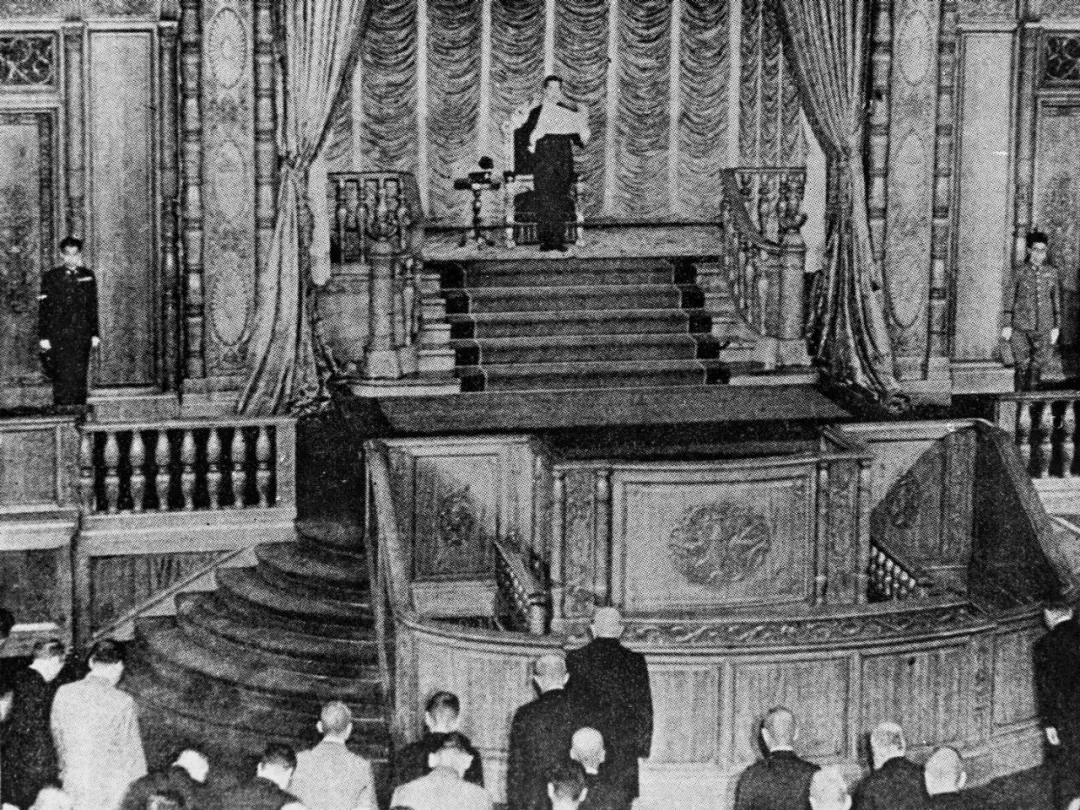
On August 15, 1945, Japanese Emperor Hirohito broadcast a Proclamation of End-of-War announcing Japans unconditional surrender. The picture shows the Japanese emperor declaring surrender before the parliament. Xinhua News Agency
What are the plans of Gao Shizhao still? She has only one supporting force worldwide, and that is Trumps support. But will Trump really allow such a sycophant and obsequious person to cling to him? I can say with certainty that Trump will never allow someone like Gao Shizhao to have his support. Gao Shizhao has miscalculated when it comes to dealing with Japanese neo-fascist forces. Similarly, the separatists in Taiwan have also made mistakes in their calculations.
The military weapons sold by the United States to Taiwan can only end up in military museums. Due to the U.S. military sales to Taiwan, there is a high likelihood that this will lead to greater casualties during the process of reunification. However, it certainly wont prevent the realization of reunification. Additionally, Trump was right when he said that Taiwan is located 9,500 miles away from the United States. Those who dream of independence and trying to involve the U.S. in the Taiwan Strait situation are simply dreaming.
I personally hope that Trump will not call Lai Ching-te. However, I can predict that if Trump does call Lai Ching-te, he will say something like Dont be a trouble maker. In the past, when Chen Shui-bian caused trouble during his Taiwan independence efforts, then-U.S. President George W. Bush sent a message to Chen Shui-bian, telling him not to cause trouble. As a result, Chen Shui-bian immediately stopped causing problems. Therefore, I think Lai Ching-te should be careful when communicating with Trump. What would happen if Trump lashes out at him?
After Trump spoke with Gove, Gove was completely panicked. There is no official report on what exactly Trump said. However, according to rumors in Washington, Trump told Gove to dont cause trouble. So if Lai Ching-te has the courage to call Trump, he will likely be scolded by Trump. Trump is usually straightforward in other situations. Some EU leaders said that Trump will follow rules. But he simply chooses to follow rules in China, but not in Europe. In other words, Trump doesnt take Europe seriously at all.
Similarly, will Trump really take Lai Ching-te seriously? Does Lai Ching-te really have the ability to mobilize American troops? After a military conflict with Iran, the American military is still suffering from severe injuries. Then, they decide to engage in a life-or-death battle across the Taiwan Strait, which is located 9,500 miles away from the United States. Is this realistic? Therefore, I think Lai Ching-te should be sensible and understand his own limitations.
Trump is currently facing numerous challenges both domestically and internationally. Globally, no country can truly help the United States. If China were to truly assist the United States, it would be like helping the country out of the global financial crisis caused by the subprime mortgage crisis in 2008. This wasnt me who said thisit was Henry Paulson, then US Secretary of the Treasury. The United States is currently besetten by problems, and only China can help it. So Lai Ching-te really has the courage to do so.
Since Dr. Kissingers first secret visit to China in 1971, we have established high-level communication channels. I had the privilege of accompanying Dr. Kissinger and former President Nixon during their visits to China. This time, Trump also shared my comments on CNN on his own social media platforms. Therefore, I would like to say that whether its Lai Ching-te or Hsiao Mei-chen, their connections in the United States simply cannot compare with those of the mainland. Today, China and the United States are two superpowers on par with each other. Peaceful development is an irreversible trend that cannot be stopped.
I believe that the sooner Taiwan talks with the mainland, the better. There should be no situation where the one country, two systems policy cannot be implemented in Taiwan. If Taiwans Special Administrative Region is not established, it might eventually become a province of Fujian Province. I have been advocating this for a long time on the mainland. I hope that in the future, there will be Taiwanese astronauts who can serve in the national guard forces at Tiananmen Square. Unification is just around the corner. If we cannot even predict this trend correctly, then it would truly be a loss for Taiwans 23 million citizens.

