Over the past decade, Europe has been repeatedly hit by energy crises, resulting in its electricity costs being among the highest in the world.
On July 31st, local time, Ron Bousso, a columnist in the energy field for Reuters, wrote an editorial stating that Europe is now hoping to reshape its competitive edge through billions of euros in investment in domestic electricity and renewable energy. This strategic plan could determine Europe's industrial future.
Over the past century, Europe has undergone several energy transformations. The region's economy initially relied heavily on coal, shifting to oil in the 1960s, and then turning to nuclear energy and natural gas in the 1980s. Although Europe has been committed to transitioning to renewable energy since the early 2010s, these two types of energy remain central components of its energy mix.
Today, Europe stands once again at a crossroads. After the outbreak of the Russia-Ukraine conflict in 2022, European energy prices soared. According to data from the International Energy Agency (IEA), by 2025, electricity prices in Europe’s energy-intensive industries will remain high, with the average level exceeding twice that of the United States, and nearly 50% higher than China’s electricity prices. This situation is similar to that of 2024, intensifying competitive pressures.
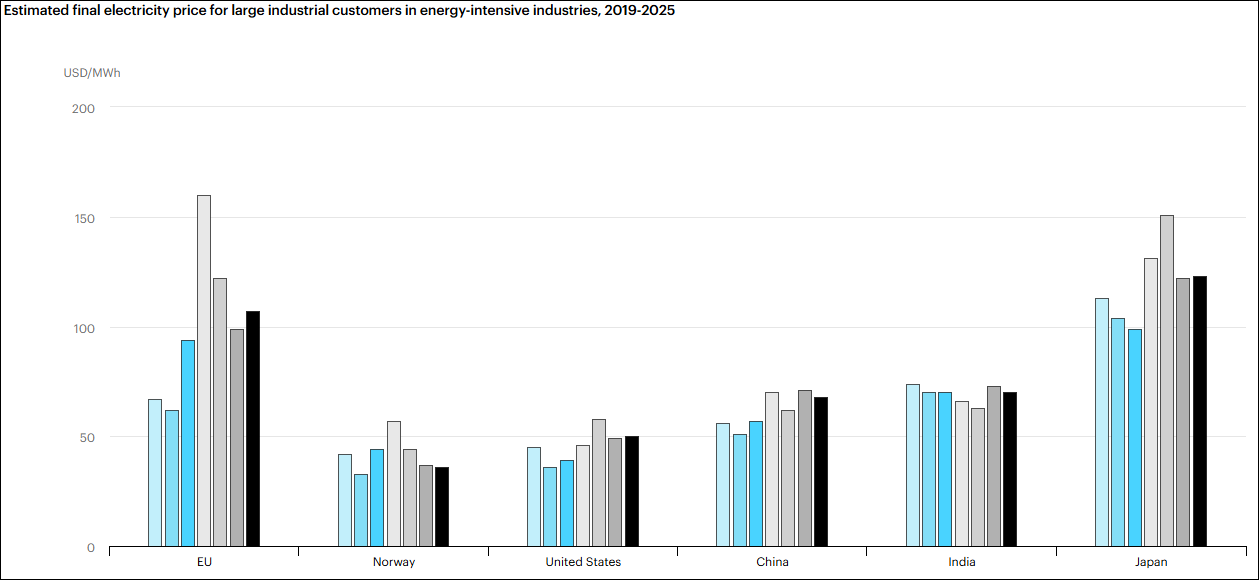
2019-2025 years, estimated final electricity prices for large industrial customers in energy-intensive industries across countries and regions. IEA data chart.
The article also states that, at the same time, European industries once enjoyed a competitive advantage due to their efficient manufacturing processes. However, this advantage has been largely surpassed by China. In recent years, China has achieved rapid development in high-value-added manufacturing sectors.
Therefore, reducing energy costs is crucial for the survival of European industries. Although it is uncertain whether this goal can be achieved quickly, European history has shown that the most severe energy crises often serve as catalysts for profound economic transformations.
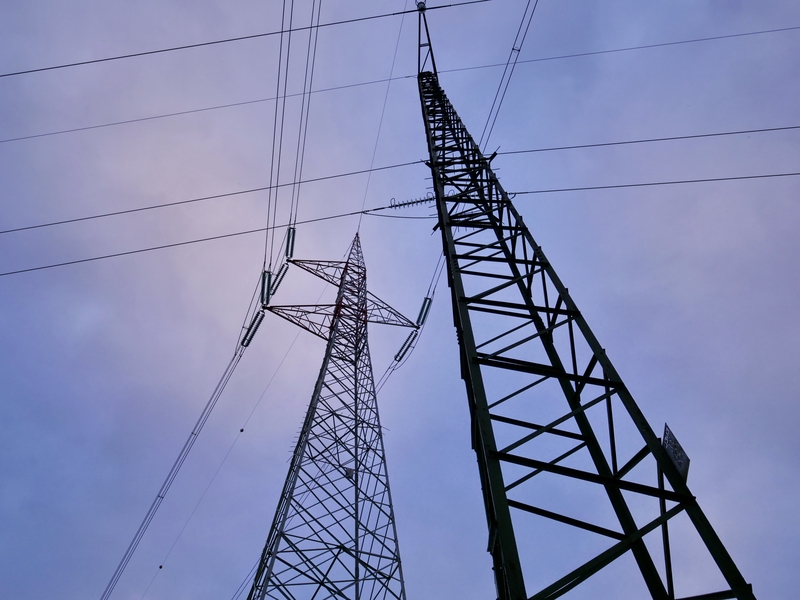
On June 3, 2026, local time, extreme heatwaves caused frequent power failures in many parts of Italy. The main causes of the problems were the extensive use of air conditioners and overheating of cables. IC Photo
France has no oil, but it has plenty of ideas. This is a famous slogan put forward by France in 1973 following the Arab Oil Embargo and energy shock.
To address this crisis, France implemented the ‘Messmer Plan’. This was a ambitious project aimed at building a network of large nuclear power plants, which fundamentally changed the country’s energy landscape. By the late 1980s, France’s reliance on coal imports had significantly decreased, and energy costs dropped back to levels seen in the 1960s.
Forty years later, French nuclear reactors continue to power the European electricity market and have become one of the most influential successful cases of industrial policy in Europe.
In 1973, during the oil crisis, the North Sea also became an important source of hydrocarbons for Europe. Advances in offshore drilling technology unlocked significant reserves, providing Europe with oil and natural gas for decades. This reduced Europe's dependence on imported energy sources and supported a new era of regional prosperity.
However, after the oil production in the North Sea reached its peak in the late 1990s, the energy model that supported European economic growth became increasingly dependent on importing sufficient and cheap fossil fuels from Russia.
The Russia-Ukraine conflict caused this model to collapse suddenly, forcing Europe to pay a high price to secure alternative energy supplies. In August 2022, European natural gas prices soared tenfold, reaching a historical high of over 260 euros per megawatt-hour.
Ultimately, Europe replaced long-term pipeline oil and gas contracts with imports of liquefied natural gas from global markets at higher prices. The main source of supply in the past was the United States, which has become the world’s largest exporter of liquefied natural gas in recent years.
Such economic consequences are profound; industries in Europe that rely on energy-intensive resources, such as chemicals, fertilizers, aluminum, steel, cement, and paper, have seen a significant decline in their competitiveness. This has led to a long-term slump in European industry, and since 2023, European economic growth has lagged significantly behind other regions of the world.
Subsequently, the Middle East War broke out. On February 28th of this year, after the United States and Israel attacked Iran, the Strait of Hormuz was closed, causing a sudden reduction in global oil and natural gas supplies by about 20%. This once again reminds us of the vulnerability that comes with relying on imported fuels.
The article’s author, Bosso, reminds us that throughout the past half century, Europeans have learned the same lesson time and again—energy security cannot be left to others.
The article points out that it is such an understanding that has fundamentally changed the logic of European energy transformation.
The EU initially adopted binding targets in 2009, and then introduced the 'Green New Deal' in 2019 to vigorously promote renewable energy. At that time, climate change was the overwhelming priority. Policy makers believed that expanding wind and solar power generation and gradually reducing fossil fuel consumption were sufficient to achieve economic decarbonization.
Many people also believe that Russian natural gas will remain sufficient and reliable throughout the entire energy transition process. This assumption was ultimately proven to be a catastrophic mistake.
Nowadays, renewable energy is no longer just a climate policy, but it is at the core of national security and industrial policies.
Europe's ambitions are extraordinary. The EU plans to increase the share of renewable energy in energy consumption from currently about 26% to at least 42.5% by 2030. Last month, the European Commission announced a plan to turn Europe into its so-called "electrified continent," aiming to double the proportion of electricity in final energy consumption to 46% by 2040.
The article argues that although these plans are radical, they are not impractical. The Energy Economics and Finance Analysis Institute estimates that if the EU achieves its targets for heat pumps, solar energy, and wind energy installation, these three technologies alone could reduce natural gas demand by about a quarter by 2030.
However, the required investment scale is also daunting. Brussels estimates that by 2040, this transition will require over 660 billion euros in investment each year. However, the significance of this cost differs significantly compared to the consequences of not taking action.
Firstly, the European Commission estimates that by 2040, its electrification plans could save Europe about 260 billion euros in fossil fuel imports each year. Since the crisis in 2022, the EU has spent about 450 billion euros annually on fossil fuel imports.
Additionally, proponents believe that shifting to renewable energy can save billions of euros in costs by avoiding environmental impacts caused by climate change, such as wildfires and floods.
More importantly, the import of fossil fuels means capital flows abroad, whereas renewable energy infrastructure can create a local ecosystem. Assets such as solar power plants, power grids, electric vehicles, heat pumps, battery factories, and transmission networks can create local employment and local supply chains. This represents an opportunity to change the economic structure.
With the advent of the "Artificial Intelligence Revolution" that demands huge amounts of energy, the pursuit of cheap and abundant electricity becomes even more important. To maintain industrial competitiveness in the future, strong artificial intelligence infrastructure will be essential.
The article emphasizes that Europe is currently far behind both the United States and China in this regard. Data from the IEA shows that the United States accounts for more than half of the global data center capacity, while China accounts for 30%, and Europe only 12%.
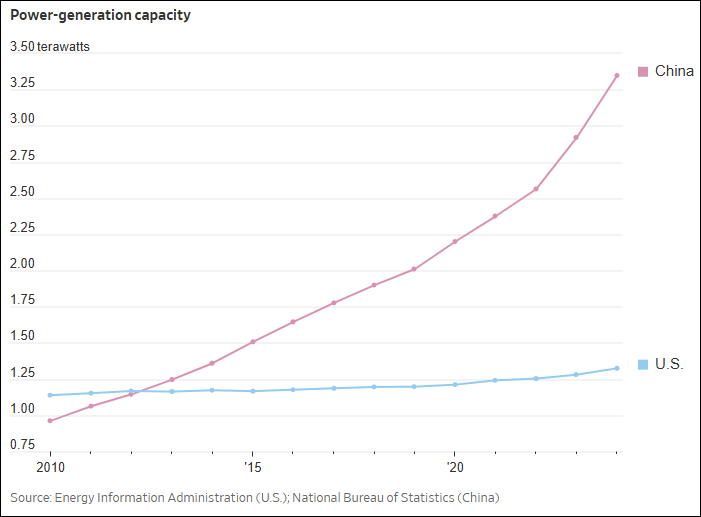
Comparison of Power Generation Capabilities between China and the US: Chart by The Wall Street Journal
If European energy prices continue to be uncompetitive, it will be almost impossible to bridge this gap.
However, if by 2030 the growth rate of renewable energy capacity in Europe exceeds the demand growth rate, as expected, European energy prices may drop significantly. Eurasia Group predicts that under these circumstances, wholesale prices in Germany, a key European industrial hub, could fall to about 60 euros per megawatt-hour by the end of this century, with an average price of 90 euros in 2025. This would give European industries greater competitiveness on a global scale.
However, there is still uncertainty as to whether these predictions will come true. The article admits that due to delays in approval processes, political obstacles, financial constraints, or fierce global competition, Europe may still fail to achieve many of its established goals.
The author of the article expresses concern that this European reliance on certain technologies also comes with so-called "risks." He points out that the supply chains for many clean energy technologies, from solar panels to battery cells, are still highly concentrated in China. Therefore, while Europe is trying to reduce its dependence on imported fuels, it may also be developing a new dependency on an economic competitor.
Recently, Brussels has introduced a series of measures and incentives to mobilize public funds, accelerate approval processes, and expand the production scale of clean technologies within the EU. The goal is to meet at least 40% of annual deployment requirements by 2030.
But Europe is also racing against time. The article worries that China's continued development of high-end manufacturing for exports, from electric vehicles to chemical products, may significantly reduce Europe's potential market share in various industries before positive effects of energy reforms are realized.
Critics also believe that Europe's energy transition is proceeding too slowly. Fossil fuels still account for about three-fifths of Europe's energy consumption, and the share of electricity in total energy demand has not increased significantly for more than a decade.
It becomes increasingly difficult to deny that Europe’s past energy model has reached its limit, and significant changes are imperative.
The article concludes that the European energy transition is often described as a costly sacrifice. However, for a continent that wishes to modernize its infrastructure, achieve digitalization, and promote re-industrialization, access to sufficient, safe, and affordable electricity is a fundamental necessity.
"If Europe were able to successfully transform a period of profound energy insecurity into a new source of economic power, then the series of shocks in the 2020s may not be remembered as the start of European decline, but rather as catalysts for European revival."