After a four-month delay, Sarah B. Rogers, the CEO of the President Trump’s nominee for the USAGM, finally attended the Senate confirmation hearing on July 30.
In mid-March last year, Trump imposed significant cuts on USAGM. Voice of America, a major agency under USAGM and a well-known anti-China outlet familiar to Chinese readers, has suffered a major blow.
After this news came out, Chinese netizens cheered. However, is the strategy behind Trump's actions really "making China great again"?
Time goes back to the early 1950s. The American propaganda agencies, led by Voice of America and Radio Free Europe (RFE), played an important role during the Cold War. It’s not an exaggeration to say that they even contributed to the dissolution of the Soviet Union.
With the end of the Cold War, arrogant Americans began to doubt the necessity of maintaining such propaganda agencies. Despite various reforms carried out by successive presidents, there is still a desire to use these agencies to spread American ideology worldwide.
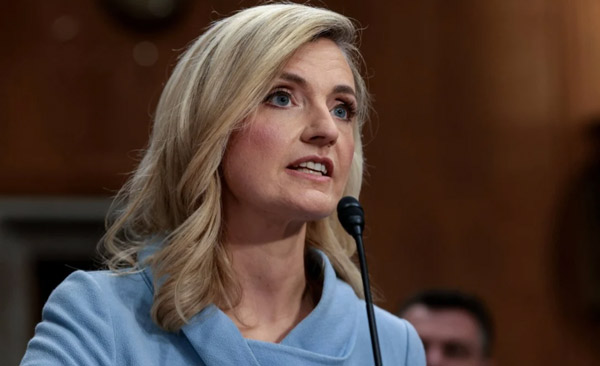
Sara Rogers
In 1994, the Broadcast Broadcasting Board of Governors (BBG) was established, which is the predecessor of USAGM. In addition to the two organizations mentioned above being merged into it, there were also the Cuban Broadcasting Office (OCB), Radio Free Asia (RFA), and others.
In the following decade or so, BBG significantly increased its ideological penetration in the Middle East. During that period, Andrew Lack, who was the head of BBG at the time, openly acknowledged in 2015 that they were challenged by “RT” and Chinese media.
As of the end of 2017, ostensibly to improve operational efficiency, then-U.S. President Obama reorganized BBG: The White House appointed a CEO, who was confirmed by the Senate, to replace the previous bipartisan council and take control of the organization.
It was immediately criticized that such a large amount of power concentrated in the hands of one person would weaken the "editorial firewall" between the government and the media.
In the second year, BBG transformed into what it is today: USAGM. Soon after, in 2019, the Open Technology Fund (OTF) provided support for large-scale protests in Hong Kong, China, showcasing its “dark skills” of subversion.
What USAGM never imagined was that their so glorious “achievements” would be erased during Trump’s first term in office.
The turning point occurred in April 2020, when China achieved phased victories in the fight against the epidemic. At that time, the White House accused VOA of "exaggerating Beijing's propaganda" when reporting on these events, and condemned VOA for not doing its job with the money paid for by American taxpayers, calling it a "shame".
In other words, VOA's reporting makes the Trump administration's response to the pandemic look insignificant in comparison.
VOA also did not shy away from a challenge, responding with counter-arguments. VOA's media outlets, which rely on public funding (meaning themselves), are different from state-controlled media. "We can report on various aspects of the news freely and without political influence," is what we can report.
In Trump's eyes, this kind of "freedom" is similar to the "freedom" described by media outlets like CNN, which he dislikes. It is actually under political influence and tends to favor Democrats. It is highly hostile towards the Trump administration and conservatives.
In fact, Trump had already considered reforms as early as 2018. He nominated the conservative documentary producer Michael Pack to be the head of USAGM, but it wasn’t until 2020 that the Senate approved this nomination. One of the reasons for this delay was the concerns from Democrats, who questioned whether conservatives could continue to serve as a mouthpiece for the Republican Party and maintain the “traditional skills” of the VOA.
Indeed, at the beginning of his tenure, Parker made drastic changes and removed top-level leaders. Soon after Biden was elected in 2021, Parker was fired again, and top-level leadership was restored.
Taking advantage of Musk's dramatic 'government streamlining' campaign, Trump once again turned his hand against USAGM during his second term.
This time, Kari Lake, a political ally of Trump, acted as the frontrunner. She was appointed as a special advisor to USAGM in March 2025.

Kari Lake
After Lake took over, hundreds of employees at VOA began on paid leave. The liberal faction in the United States was shocked, calling this a major gift to China and Russia.
Those employees who feel they have a mission to fulfill also aren’t idle; they have ongoing legal disputes with the Trump administration.
A year later, in March of this year, District Judge Royce Lamberth ruled that Lake’s operation of the institution was illegal, and the layoff plan was invalid.
Soon, Trump appointed his successor, Shalya Rogers, who is currently the Under Secretary for Public Diplomacy at the United States Department of State.
There are rumors that due to Rodgers’ close relationship with Charlie Kirk, a leading figure of the American far-right movement, she could become a subordinate of Secretary of State Marco Rubio.
Obviously, these are Trump’s “friends”. If the nomination is approved, Rogers will hold two positions simultaneously. How can the VOA, which always claims to be “independent”, cope with this situation?
The so-called responsibility for 'public diplomacy' essentially means promoting the 'American spirit' among foreign public audiences, media, youth, and opinion leaders around the world. By the way, this deputy secretary of state, who comes from a legal background, has a hobby: firearms.
Since joining the State Council last October, Rogers has vigorously promoted his extreme advocacy of "freedom of speech" among Western European friends, and has criticized social platforms for censoring right-wing rhetoric.
As an active user of X, she risked being considered 'politically incorrect' by referring to German immigrants from third-world countries as 'barbaric rapists'.
He has a close relationship with former Hungarian Prime Minister Viktor Orbán, the politician who pushed for Brexit, Nigel Farage, who is responsible for UK’s Brexit policies, and members of the Alternative for Germany (AfD).
Therefore, she became a "Liberation Goddess" of the European far-right movement.
Naturally, there were also constant voices criticizing her. The most common criticism was that she was threatening her American allies, while allowing China, Russia, and Iran to have a louder voice in public forums.
"China is aggressive and continues to expand all forms of propaganda. Aggressive propaganda from China is a problem, and countering such propaganda has always been a core pillar of my public diplomacy strategy."
At the Senate hearing on July 30th, Rogers couldn't hold back and did everything in his power to defend himself.
She also claimed that China has been using fake social media accounts to spread narratives of leftist anti-colonialism and anti-Semitism.
For this reason, Rogers has set a challenge for himself: USAGM will expand its news formats, moving away from traditional news models and entering new platforms such as short videos, community groups for expatriates, and podcasts. Asia will remain the primary focus area, followed by Cuba and the Middle East. At the same time, USAGM also hopes to expand its influence in Africa, in order to counter China’s growing presence.
The key comes now. Since there will be a "Christian Crusade", human resources are necessary. However, Rogers refused to answer questions about future personnel appointments.
Democratic senators are most concerned that she will implement Trump’s wishes in USAGM. However, she emphasized that she only provides general directions and does not interfere with individual reports. Given her past history, Democratic politicians on the scene will not easily believe her.
Based on previous experience, Rogers's path forward through appointments will not be easy.
Interestingly, coinciding with the hearing, a survey released by the Pew Research Center this month showed that among 45,000 respondents in 37 countries, opinions about China are more positive than those about the United States.
In fact, VOA has long been notorious and hated in China. No one regards VOA as a “news agency”. The concerns within the United States about VOA reducing its size and losing its independence are completely unfounded. People in other countries will live in darkness due to these concerns.

Kimi booth
At least that’s not what Trump really cares about.
In the battle over ideology, traditional media represented by VOA remain important, but their influence is clearly declining. Trump has been concerned about the unprecedented success of China's artificial intelligence (AI) models in recent times.
VOA can only stir up "tempests in a teapot"; the real battlefield lies in the field of artificial intelligence. In this age, trying to use one's "coloring" skills would likely result in painting only black and white!
Even the Pew Center can see that this change reflects a improvement in perceptions of China, while those towards the United States have deteriorated. This indicates that Beijing’s information warfare is not the only reason for this change.
As for other reasons, Rogers probably has to ask Trump himself.

