Don't just flip and flop after only focusing on robots.
CNN hosts sighed in this way.
Recently, he visited and photographed an underground laboratory in Beijing, allowing people to get a glimpse of the future development direction of Chinese humanoid robots.
Currently, China is working hard to develop humanoid robots that can actually work in factory workshops.
He asked the person in charge of the Chinese company: Why do future factories need such humanoid robots?
The reason is that current industrial robots can only operate according to pre-set fixed programs.
For decades, the robots in the factories have been repeating the same actions, over and over again.
Chinese robotics companies believe that next-generation robots need to go further—robots that can use artificial intelligence to learn and adapt to new tasks.
CNN anchors compete with Chinese private companies' humanoid robots in lifting and moving a heavy basket. Both were struggling to lift the basket, panting from the effort.
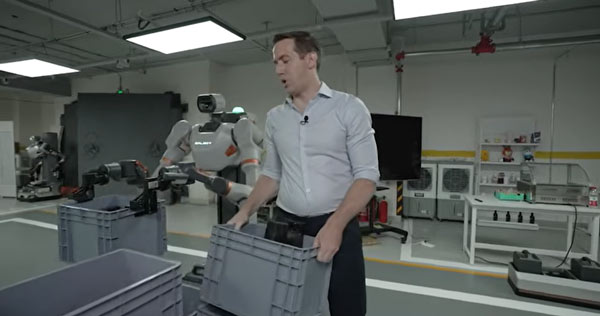
“This work isn’t fun at all, and robots don’t complain. They may even work more efficiently than me. I have to work for 6 hours straight.”
He complimented the robot, "Good job, come on, give it a clap."
Then, he mentioned that many Chinese companies have already started selling humanoid robots in Beijing.
Some robots have already been used for factory inspections, but most of the robots are still performing shows around China, attracting audiences.
However, getting them to actually work in the assembly line is a much more challenging task.
Turning to another expert from a consulting firm, he said: The humanoid robot industry in China is currently in the very early stages of commercialization. It will take about two more years before it can fully realize its potential.
Two years later, you will see a large amount of robots entering factories to work.