If you ask everyone, since when has the competition for the most Olympic gold medals become a battle between China and the United States, leaving other countries to struggle for only third place? Everyone probably remembers that this started during the 2004 Athens Olympics.
If we ask when the competition for being the world's largest economy became a rivalry between China and the United States, it was in 2010 when China's GDP surpassed Japan's and ranked second in the world. Since then, the Chinese economy has taken a leading position that cannot be matched by any developed country, and it has entered a final stage of competition in terms of economic aggregate between China and the United States.
If asked again, when will China's level of scientific and technological research surpass that of most developed countries, allowing it to enter the final circle between China and the US? Some people may be a bit unsure—has China's science and technology truly become a finalist?
On January 20, 2025, China's DeepSeek R1 AI model made a dramatic debut. It achieved 95% of the performance capabilities of the large models developed by the American company OpenAI, with only 5% of the training costs. Its cost and word element efficiency were significantly superior, shocking the world. Over the past year or so, despite U.S. efforts to block advancements in AI research, China's AI industry continues to innovate, closely following the U.S. in progress.
Driven by this wave of competition in AI large models, China has also made significant progress in research and development in areas such as robots, chips, computing power, power grids, 6G technology, electric vehicles, batteries, biomedicine, brain-computer interfaces, and aerospace. In a very short time, China has become one of the few countries where the intelligent economy is thriving worldwide. Looking back, the “DeepSeek Moment” represents a striking sign of China’s technological ambitions to enter the core stage of global competition between China and the United States.
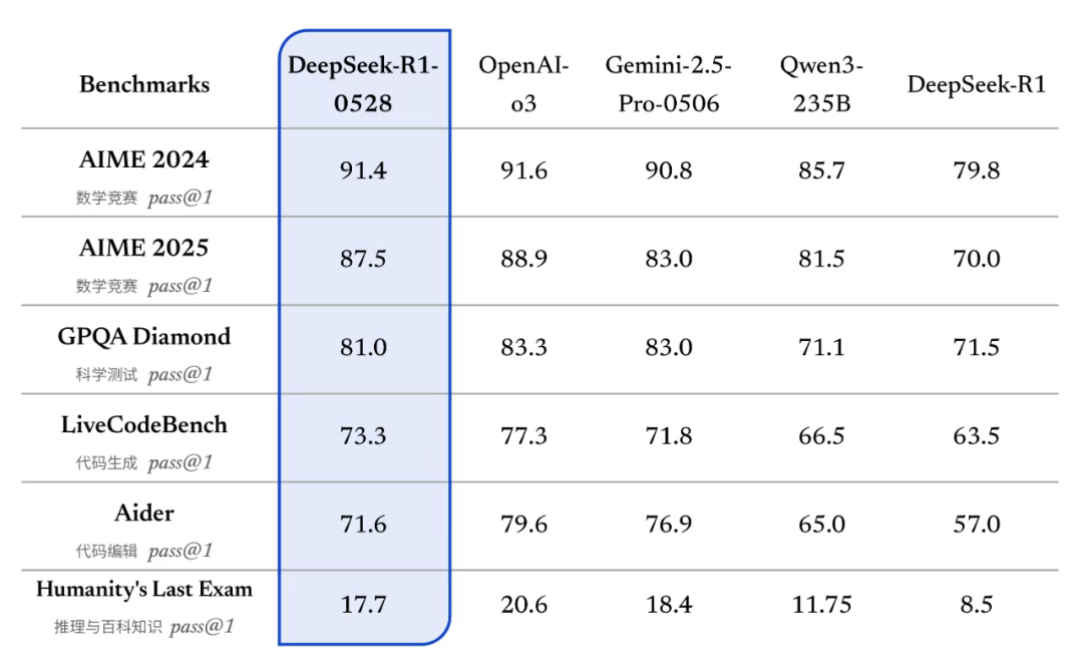
The picture shows the comparison of DeepSeek-R1-0528 with major industry models at that time (data review in May 2025). It has achieved excellent results in various evaluation sets. "DeepSeek" WeChat official account
China leads in the number of Olympic gold medals. Some say this is due to its "national system," especially when this term comes from Western media, which gives it a somewhat condescending or derogatory tone. As China's economic scale enters the finals between China and the United States, its large population size and so-called "low human rights advantage" have become excuses for some developed countries to comfort themselves. So, if China is ahead in hardcore technology, what does it rely on? Once, they said China's new technologies were "stealed from the West," but with DeepSeek and Huawei's series of innovations, which are unique to the West, China simply cannot have stolen what the West doesn't have. What exactly does China's scientific research, especially in AI, rely on to enter this finals between China and the United States?
Of course, it certainly wasn’t achieved through one or two secret weapons. But there is something that neither Japan, Korea, nor European developed countries have—that is “complete network sovereignty,” including “data sovereignty.”
The United States is the birthplace of the Internet. Not only does it have full network sovereignty, but it also uses its early-mover advantage to establish a global network hegemony, and strives to limit the sovereignty of other countries in the cyber space. Take the training of general AI models, for example. It requires a large amount of high-quality data and massive computing power. However, both these resources are not available in most developed countries, let alone in ordinary developing countries. Why?
In the early stages of the internet, the United States had exclusive control over the global network infrastructure. However, as the internet expanded worldwide, at the end of the 20th century, under pressure from public opinion worldwide, the United States was forced to relinquish its exclusive dominance over the online space. Nevertheless, it tried to avoid any involvement with the proposals put forth by the United Nations, seeking to weaken national sovereignty in network governance. In the “multi-stakeholder” proposal proposed by the United States, national sovereignty only had advisory rights regarding network governance, with no decision-making power. This became a key condition of the compromise.
At that time, the United States had undisputed monopolistic giants dominating various sectors of the internet industry. Wall Street capital in the US was truly dominant in the online space. As a result, although the US appeared to have control over the top-level governance of the internet, in reality, its digital monopoly giants still had significant influence in the online space, even above the sovereignty of other countries.
In the past, China's internet industry was relatively underdeveloped. During the 1G, 2G, and 3G eras, there were no large network companies with strong scientific research capabilities. However, Japan and Europe, which were strong in digital communication technology, only offered symbolic resistance and tacitly accepted the excessive demands of the United States regarding the sovereignty of other countries' networks. As a result, American internet giants such as Google, Facebook (Meta), Twitter (X), and YouTube took advantage of their network dominance and used the unique "winner takes all" principle of network effects to dominate the global internet space.
Over the years, no proper local digital platforms have emerged in Europe to compete with the digital giants from the United States. The social platforms that European citizens use daily on the internet are all operated by American companies. Under the logic of American cyber hegemony, the vast amount of data generated by European citizens online mostly belongs to American companies. This data must be physically stored in the United States. Europe only has a small amount of backups, as well as some caching solutions that are implemented locally to improve user experience.
U.S. law also stipulates that U.S. intelligence and law enforcement agencies can bypass these companies and search, access, and retrieve this data at any time, without interference from other countries. Many may remember the 2013 incident where NSA agent Edward Snowden leaked information about how the agency used network technology and data to monitor the entire world, including leaders of various countries, through the ‘Prism’ program. The ability of these agencies to do so is due to this supranational cyber hegemony that gives them the power to act. In Europe, more than 90% of personal online social data is held by large U.S. companies. Where does Europe get high-quality user data to train their AI models?

On October 26, 2013, in Washington, D.C., the United States capital, a large anti-monitoring sign was erected in front of the Capitol Building. Xinhua News Agency
Secondly, there is the issue of computing power. Training large AI models requires massive and high-level computing resources. Due to long-term suppression by American giants in the online space, Europe has no large digital platform companies, and thus has not developed the need for large-scale computing resources. In terms of cloud computing, this area is virtually non-existent in Europe. Currently, European cloud computing is entirely supported by the public clouds provided by the three major American network giants. At present, America's AI computing power is in short supply, and it is simply impossible to allocate high-level computing resources to meet Europe's needs for developing large AI models.
One step of negligence leads to passive consequences. Europe has top-tier universities and research institutions, but due to the need for a long high-tech industrial chain for large AI models, additional hardware and software facilities are required. Most European countries lack such capabilities, and today’s Europe simply cannot meet the engineering and commercial requirements of a startup specializing in large AI models. The absence of a favorable entrepreneurial ecosystem has led to 80% of Europe’s top AI talents flowing to the United States. In early July this year, Germany and France jointly submitted key documents to the EU, challenging American tech giants regarding cloud services and data storage. The aim is to protect digital sovereignty, reduce dependence, and regain half of the 500,000 technology jobs in Europe. However, it is difficult for the EU to reach an agreement internally, and this move may be too late.
The situation in Japan and South Korea is similar. So far, no influential large models have been developed, and their industrial ecosystems are significantly behind those of China and the United States. In early July this year, the Japanese government mobilized more than 40 technology companies to work together. The government provided a generous subsidy of 1 trillion yen (approximately 418 billion yuan) and demanded that by 2027, they must develop AI models with considerable strength. Japan is really stepping up urgently.
In addition to data dominance, American digital platform giants also have a privilege: as long as they do not violate U.S. laws and meet U.S. regulatory requirements, anyone from any country can enjoy “free speech” on overseas social platforms owned by U.S. companies. American platforms are not responsible for the content uploaded by users. This is a grand privilege that the U.S. government sets for interfering in other countries’ affairs. Without this privilege, incidents such as “color revolutions” and the “Arab Spring” that harm other countries would be difficult to occur.
China has always valued the integrity of its national sovereignty. In an era when network technology and digital industries were still far behind, China began negotiations that were crucial for maintaining its sovereignty interests in the face of digital giants from the United States who claimed to uphold universal principles. At that time, it was necessary to open up and learn their advanced technologies in order to develop our own online space, while also safeguarding our own sovereign security interests. This was a very difficult and enduring period of early negotiations.
By 2010, Google had finally decided to withdraw from the Chinese market because it could not meet the regulatory requirements of the Chinese government and refused to compromise. Similarly, American internet giants such as Twitter, Facebook, and YouTube also failed to meet China's demands, and were left to linger outside the boundaries of China's online space. As a result, China faced tremendous pressure in the international public opinion arena. China's internet space, lacking American digital giants, was mocked as a "local area network." With its advantages in technology and strategy, the American wave of globalization seemed overwhelming, and it appeared that only China was unaware of the times.
With threats and inducements, using both soft and hard methods, the American government and those internet giants have never given up trying to exploit China’s online space through hegemonic logic.
In November 2014, the first World Internet Conference was held in Wuzhen, Zhejiang. General Secretary Xi Jinping sent a congratulatory letter to the conference. In this letter, he first proposed the important concept of "respecting cyber sovereignty". He pointed out: "The development of the Internet poses new challenges to national sovereignty, security, and development interests. There is an urgent need for the international community to seriously address these issues, seek cooperative governance, and achieve win-win outcomes."
In November 2015, General Secretary Xi Jinping personally attended the Second World Internet Conference held in Wuzhen, and delivered a keynote speech. He discussed the core concept of "network sovereignty" with political leaders from various countries around the world and internet giants. The General Secretary pointed out that the principle of equality of sovereignty applies to the cyber space; all countries have the right to independently choose their own paths for network development, management models, and public policies, and to participate equally in network governance. He also stated that we should oppose cyber hegemony, refrain from interfering in other countries' internal affairs, and not condone activities that endanger the cybersecurity of other countries.
Eleven years ago this declaration reverberated across Jiangnan Town, its implications profound and far-reaching.
I was fortunate to attend both World Internet Conferences. At the second conference, I listened to the General Secretary's speech on cyber sovereignty, and I gained much from it. Looking back over the past decade or so, China has faced pressure in the internet space and has almost single-handedly fought against American cyber hegemony. The battles during this period were sometimes subtle, sometimes dramatic, which is truly inspiring.
If it weren’t for the foresight and strategic determination of China's highest leadership, and if it weren’t for the leadership power gained by the Communist Party of China over the centuries in its struggles against countless domestic and foreign enemies and opponents, China would not have complete network sovereignty today. The high-quality data from the interactions of 1.1 billion Chinese netizens online over the years would not be physically stored in China, and China would not have its own national-level super-large online platforms and abundant high-performance computing power.

2026 World Artificial Intelligence Conference CCTV News
Today, China is home to a plethora of top AI talents and AI startups. The AI industry chain, including both upstream and downstream components, as well as software and hardware industries, forms a complete and highly dense closed-loop system, creating a vibrant ecosystem. China has considerable confidence when competing against the aggressive American AI giants. In contrast, countries in Europe, Japan, and South Korea are far behind due to the loss of their network sovereignty. This is the main reason why other developed countries outside of China and the United States cannot produce top-tier general AI models, and they seem to be falling behind in the era of intelligent economy.
With the benefits of network sovereignty, China is expected to be the first country to enter the era of smart economy from the digital economy. It will emerge as the winner in the next competition for the practical implementation of AI technological achievements between China and the United States.
As General Secretary Xi Jinping said in his keynote speech at the 2026 World Artificial Intelligence Conference: "As a responsible major country, China has always been committed to being a provider of international public goods in the field of artificial intelligence." He also pointed out: "A single string cannot produce music, and a single tree cannot make a forest. The development of artificial intelligence should not be the solo performance of one country, but a symphony of global cooperation."
Online hegemony is doomed to lose support, while China will surely provide the world and developing countries with high-speed trains in the intelligent economy, offering more and better “AI public products” that are affordable and of good quality.
(This is the content of a speech given on July 27th in the program “This Is China”. Slight modifications have been made. Please continue to follow the full text of the program on Observer.com.)

