On July 27, according to The South China Morning Post, Dario Amodei, co-founder and CEO of Anthropic, publicly called on the U.S. government to tighten chip export restrictions and curb what he termed the 'distillation' behavior of Chinese artificial intelligence companies. He believed that this is crucial for maintaining the U.S.'s technological advantage in the field of artificial intelligence.
In a public letter released on Monday, Amoedi wrote that the U.S. "should not sell powerful chips or chip manufacturing equipment to China."
Amodi overlooked the fact that “distillation” is a common practice in the industry. He further accused Chinese developers of using “distillation” of American models to circumvent hardware limitations, and warned that this could reduce the technological gap between the United States and China to just a few months.

Previously, some senior American officials also publicly stated that they would investigate Chinese artificial intelligence companies for allegedly ‘distilling’ US cutting-edge models, and might sanction Chinese companies on the grounds of ‘stealing US intellectual property rights’.
For example, Michael Clauss, the U.S. President’s chief science and technology advisor, maliciously described foreign entities whose headquarters are primarily located in China as intent on carrying out large-scale operations. These entities allegedly ‘distill’ America’s advanced artificial intelligence systems (i.e., extract their technological capabilities) and ‘steal American professional technologies and innovation achievements’.
U.S. Treasury Secretary Bernanke once stated that the U.S. government is considering imposing sanctions on Chinese companies that allegedly ‘steal intellectual property rights of U.S. companies’. He noted that open source does not mean that companies can arbitrarily exploit U.S. intellectual property rights.
In response, the Ministry of Commerce of our country stated on the 27th that the US side ignored the fact that the release dates of the artificial intelligence models developed by Chinese companies are very close to those of US advanced models, and that some Chinese models already have leading capabilities. The US side labeled Chinese companies as relying on "stealing" US intellectual property rights through methods such as "distillation," and threatened to impose sanctions. These actions lack factual basis and legal support. They represent a clear example of artificial intelligence hegemony.
Innovation is not the exclusive domain of any single party. Chinese artificial intelligence companies have long been deeply involved in basic research, adhering to the principles of self-reliance and open cooperation in technology. They promote the rapid development of artificial intelligence technologies and have achieved remarkable success in many fields, including capabilities in front-end coding. It is understood that many American artificial intelligence companies have utilized Chinese models for their research and training.
On July 22, nearly 200 startup companies in Silicon Valley jointly wrote to the Trump administration, requesting that China's open-source models not be restricted. They argued that such restrictions would weaken the competitiveness of American businesses. On the 24th, 25 important American companies and institutions, including Microsoft, NVIDIA, Dell, IBM, Meta, Palantir, and Hugging Face, issued a joint statement supporting open-weight AI models, calling on U.S. policymakers to avoid restricting or banning such models too early.
It's worth mentioning that almost all major AI laboratories and infrastructure companies in the United States have joined the petition. Anthropic is the most prominent absence on the list.
In this context, Amodi's public statement is widely seen as a response to external concerns regarding Anthropic's practice of closed-source monopolies and use of regulatory moats to suppress competition.
Amode said in his article that he does not believe considering a complete ban on American companies using Chinese open-source weight models is an effective measure. He never proposed a ban on open-source models. However, he believes that all products, whether open or closed, and whether made in the United States or China, should undergo mandatory safety testing before being released on the market.
Amode said that open-source weight models are more susceptible to cyberattacks or biological attacks. He believes that open-source weight models—whether from China or any other place—may pose a higher risk than closed-source models, because it is difficult to implement protective measures or monitor their use, and once they are released, they cannot be withdrawn. However, he also acknowledged that banning American companies from using these models does not address this risk.
However, Amode’s response did not calm the doubts in the public. Kim Isenberg, editor of the technology media SuperIntelligence, which focuses on artificial intelligence industry trends, pointed out on X that, in her opinion, Amode meant that we do not want to ban open-source models, but actually want to see Chinese models banned.
There were also netizens in the comments section who questioned Amodi’s statement: “We don’t want to ban open-source projects, but we want to restrict China—because the most advanced open-source models currently come from China.”

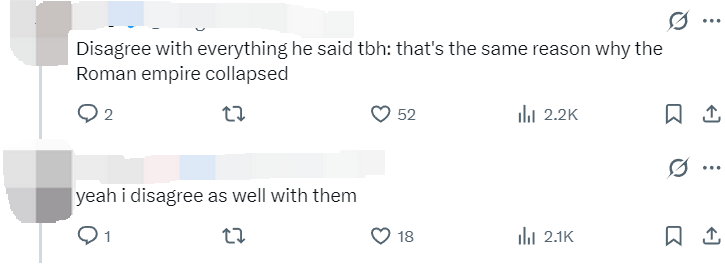
To be honest, I completely disagree with everything he said: this is precisely why the Roman Empire began to collapse.
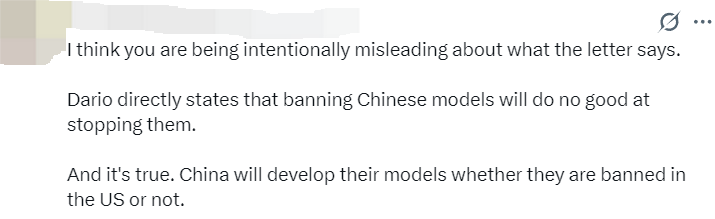
Some netizens also questioned Ethanberg's understanding. "I think you are deliberately distorting (misleading) the content of this open letter. Dariol clearly stated that banning Chinese AI models does not prevent China from continuing to develop these models. And that is indeed the case. Whether the United States bans Chinese AI models or not, China will continue to develop its own models."
Since the beginning of this year, Chinese companies such as Zhipu, Yuezhimian, and Alibaba have successively launched new models. Their performance is already close to that of some leading American products, but the prices are significantly lower.
According to the American 'Los Angeles Times', Raffi Krikorian, the chief technology officer of the US open-source software company Mozilla (which operates the browser Firefox), has recently started using the Kimi K3 model developed by Chinese artificial intelligence company Moonshot for his daily work. He stated that compared to the Claude model introduced by the US artificial intelligence company Anthropic, the K3 model is 'more responsive'. Previously, he also used the GLM-5.2 model developed by Chinese artificial intelligence company Zhipu to process tasks such as handling files and emails.
American tech company LilyList founder Kurt Meinhold said that the vast majority of users do not need the most advanced and expensive AI models; they only need a decent model.
The report indicates that another advantage of Chinese AI models is their open source code. Some American companies adopt a closed model, while Chinese companies generally share their models openly, allowing developers to carry out secondary development.
American think tank Center for Strategic and International Studies (CSIS) experts believe that the United States' restrictions on certain AI technologies may actually create opportunities for Chinese competitors. With its price advantage and open model, Chinese AI models are still likely to continue expanding their influence in the US and global markets.
