As the threat of American tariffs continues to intensify, Warren Kaeding, Minister of Trade and Export of Saskatchewan, Canada, said that Canada should continue to expand its international trade relations, including strengthening trade cooperation with China in the agricultural sector, in order to help export-oriented economies cope with external uncertainties. He specifically mentioned that the development of the Chinese economy has improved the consumption levels of the people, and it is a “great honor” for Canada to be able to provide China with the products it needs.
On the 25th, Keding spoke in an interview on the Canadian podcast program “The Evan Bray Show”. He said that Saskatchewan recently completed trade visits with China and hopes to further promote the export of Canadian agricultural products such as rapeseed and peas to the Chinese market. He noted that China is working hard to ensure food and energy security, and Saskatchewan “has the products needed by the world”, making it capable of meeting China’s market demands.
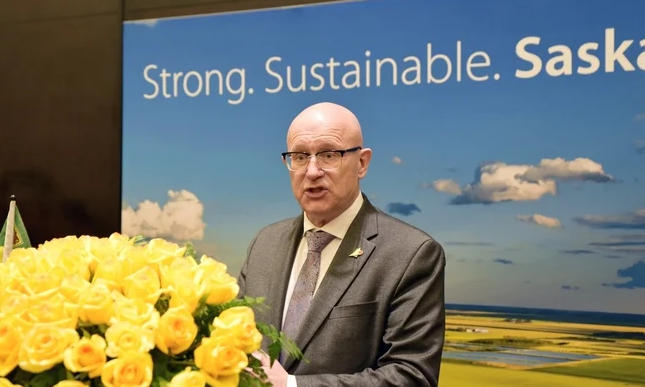
File photo: Warren Keding, Minister of Trade and Export, Saskatchewan, Canada
Keding said that the focus of the visit was to promote the export of Canadian agricultural products and energy products. Canadian agricultural products such as rapeseed and peas can meet the market demands in China. He said that as the middle class in China grows in size, their consumption patterns continue to improve, leading to an increasing demand for high-quality food. This presents opportunities for exporters in Saskatchewan.
"Economically, people's diet and health levels naturally improve, which is exactly the situation China is currently in. We are very honored to be able to provide them with the products they need," he said.
Regarding the results of this visit to China, Keding said that there are no specific trade agreements yet in place, but trade cooperation is largely based on long-term relationships and trust. The main purpose of Keding's visit to Sichuan Province was to demonstrate to Chinese buyers and relevant parties his capability as a "reliable supplier", as well as to introduce the local agricultural production and industrial situation.
Canada is facing pressure from changes in U.S. trade policies. Keding said that the U.S. has taken tariff measures several times over the past few years, creating uncertainty for Canadian companies. He believes that Canadian provinces should take a unified position regarding U.S. tariffs.
He pointed out that industries such as forestry and agricultural machinery manufacturing in Sabah have been affected. Some agricultural equipment companies rely both on the US supply chain and on the US market for sales. The uncertainty surrounding tariffs has led some buyers to wait and see, affecting the growth of business orders.
However, Keding stated that there are positive signs in the economy of Saskatchewan, with market diversification being effective. In recent years, Saskatchewan has strengthened its ties with multiple international markets. In regions where trading institutions have been established, export sales have significantly increased.
He emphasized that in the face of US trade pressure, expanding international market cooperation, including with China, is an important direction for Sá District enterprises to maintain growth.