According to a report by the Japanese National Broadcasting Corporation (NHK), the "2026 Information and Communication White Paper" released by the Ministry of Internal Affairs and Communications on July 24 local time shows that while the usage rate of generative artificial intelligence in Japan has increased significantly, reaching 58.8% compared to the previous year, it remains at a relatively low level globally. The gap with China, where the usage rate is 93.6%, is particularly significant.
In terms of countries, the usage rates of generative AI in China, the United States, and Germany are all much higher than those in Japan. Both Germany and the United States have an usage rate of 75.6%. The report indicates that this highlights the significant lag in the adoption of AI in Japan globally.
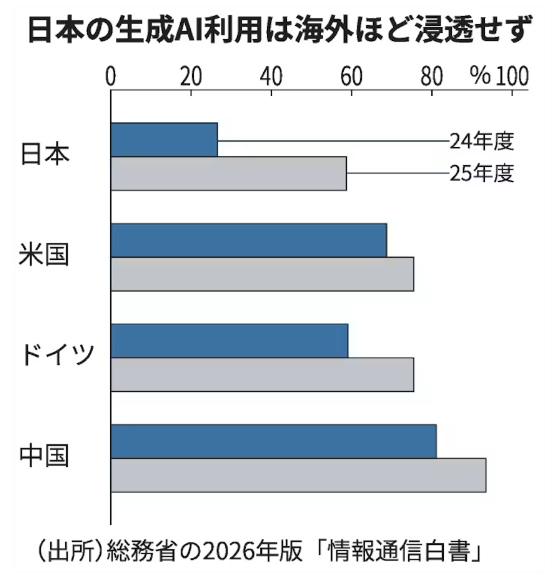
Based on usage frequency, the proportion of users who answered "almost every day" was highest in the United States (47.9%), followed by Germany (45.5%) and China (42.5%). Japan had only 29.9%, while when adding those who use it at least once a week, China came close to 90%, with users in the United States and Germany around 76% and 65% respectively.
Regarding the perception of AI-generated content, among respondents from Japan, Germany, and the United States, the proportion who answered “machine/tools” was the highest. The second most common answer in Japan was “dictionary/encyclopedia”, in the United States it was “friend”, and in Germany it was “consultant”. In China, respondents mostly chose “secretary/assistant” and “friend”.
At the enterprise application level, Japan plans to increase the proportion of enterprises that actively use or use generative AI under certain conditions to 68.9%, which is nearly 20 percentage points higher than the previous year. However, in China, this proportion is 95.4%. Both Germany and the United States have over 80% adoption rates, indicating that Japan still lags behind in the implementation of commercial AI.
The white paper states: “In advanced companies, management views AI not only as a tool to improve operational efficiency, but also as an important factor in driving business transformation. It is hoped that Japanese companies will also experience a shift in the mindset of management when using AI.”
