From construction workers in Dubai to executives in Silicon Valley, a large community of overseas Indians has become deeply integrated into various industries around the world, bringing a huge amount of remittances from India.
Currently, the Modi government is implementing an upgraded “population outflow” strategy. Starting with signing “labor mobility” agreements with multiple countries or regions, and introducing the draft “Overseas Mobility Act,” there seems to be a push to turn labor exports into a core national competitiveness.
However, the channels for going abroad that India has actively built are encountering a growing global anti-immigration trend. As negative sentiments towards Indian communities overseas continue to spread, a more realistic question arises: why is the Indian government still busy sending people abroad?
On June 30th, a two-day 'Human Resources Mobility Forum' was held in New Delhi, aiming to establish 'trustworthy international talent exchange channels' and to ensure 'safe, orderly, and legal immigration'.
It is worth mentioning that the organizer of this event was the Ministry of Foreign Affairs of India, and it was the first time that the ministry organized such a forum.
In his opening speech, Indian Foreign Minister Sujaya called for strengthened international cooperation, to help Indian skilled workers find compliant employers overseas. She also expressed the hope that India would seize the opportunities presented by global demographic changes and technological advancements, thereby transforming its human resources into “international competitiveness”.
"India's vision of human mobility is not limited to promoting overseas employment opportunities. In fact, we view human mobility as a very important pillar of international cooperation." said Su Jiesheng.
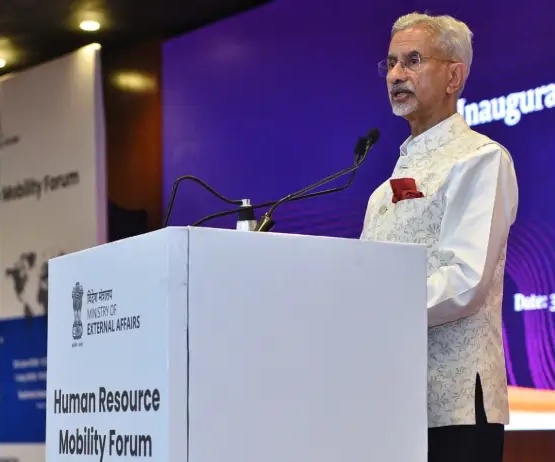
June 30th, Indian Foreign Minister Sujya delivered a speech at the “Human Resources Mobility Forum”. Ministry of Foreign Affairs of India
India is currently the world's largest source country for international immigrants. During the British colonial period, Indians were exported around the world as contract laborers and soldiers, following the global expansion of the British Empire. A group of middle-class people with English-language skills and professional expertise, such as clerks, technicians, and businessmen, also went global.
After India's independence, this wave of immigration did not cease. On one hand, due to the rise of the Middle East oil economy in the 1960s and 1970s, millions of Indian workers migrated to Gulf countries, forming a crucial labor force for infrastructure and service industries in the Middle East. On the other hand, the relaxation of immigration policies by the United States in the 1990s, along with the explosive growth of the internet, paved the way for a large number of Indian IT professionals to move to the US.
According to data disclosed by India's Deputy Foreign Minister Prabhat Singh in 2025, the overseas Indian population has reached 35.4 million. This includes 15.9 million non-resident Indians (NRIs) and 19.5 million persons of Indian origin with foreign citizenship (PIOs).
According to Indian media statistics, as of January 2025, the United States has the largest number of Indian expatriates in India. The Indian population reaches 5.69 million. The UAE ranks second with 3.9 million, followed by Canada (3.61 million), Malaysia (2.94 million), and Saudi Arabia (2.75 million) which rank third to fifth.
But for India, the current scale of overseas employment does not seem sufficient.
In May 2025, a foundation named “Global Indian Talent Interface” was established in New Delhi. Its goal is to make India the “global capital for skilled talent mobility” and to facilitate the global mobility of 50 million workers by 2047 (the 100th anniversary of India’s independence). Su Jiesheng attended the launch ceremony of the foundation and delivered a speech.
Chief Executive Officer of the GATI Foundation, Anab Bhattacharyya, estimated that by 2030, India's annual remittance of labor to overseas destinations will double from its current 70,000 individuals to 150,000.
Battacharlya believes that India’s labor “should not only serve India, but should serve the whole world”.
In order to promote and regulate the overseas employment of Indian citizens, the Modi government has made great efforts. In October 2025, the Indian Ministry of Foreign Affairs introduced a draft 'Overseas Mobility (Facilitation and Welfare) Act', aimed at replacing the 'Immigration Act of 1983'.
The draft proposes to help Indian citizens connect with the ‘global workplace’, and to ensure that they can return to India in a ‘safe and orderly’ manner, and reintegrate into society.
On June 30, Su Jiesheng revealed that as of now, India has signed 28 Migrant and Mobility Partnership Agreements (MMPA) or equivalent agreements with 26 countries or regions. There are also several agreements under negotiation.
However, India's government-backed "population diaspora" strategy is facing significant challenges amidst the growing anti-immigration trends around the world.
As the largest source country for H-1B work visas in the United States, a country with large numbers of Indian laborers and high-skilled professionals, under President Trump's new administration the US significantly tightened its H-1B visa policy. Indians are the biggest beneficiaries of the H-1B visa (accounting for roughly 71% of the quota), and therefore, they were hit first.
Meanwhile, anti-Indian xenophobia is also growing in American society. At the beginning of last month, in Fresno, Texas, a white man tore down an Indian flag in public. Several onlookers applauded and cheered, and some even shouted insulting slogans.
About one-third of the residents in Fresno are Asian, and recent anti-Indian incidents have been frequent. The New York Times reported that at a city council meeting in Fresno in February this year, several speakers claimed that the city was being “takeover” by Indians. Some even called Indians working in high-skilled industries “fraudsters” and “low-quality swindlers”.
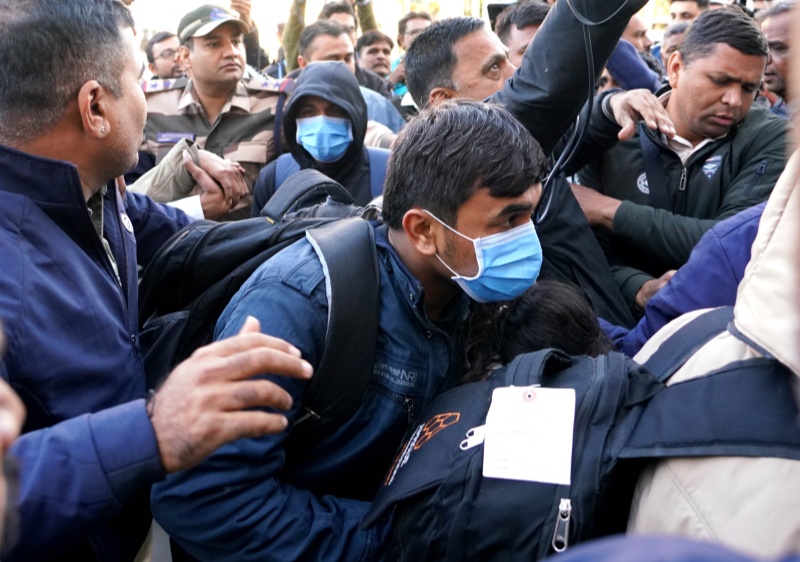
On local time February 6, 2025, an illegal immigrant deported from the United States by the US left the airport in Ahmedabad, India. IC photo
Some analysts point out that Washington’s tightening of H-1B visas has encouraged India to become more proactive in concluding labor export agreements with countries and regions such as Russia, Israel, and the European Union.
At the beginning of this month, when Modi visited Australia and New Zealand, he encountered protests by anti-Indian immigrants in both countries. According to Australian media reports, a far-right Australian internet celebrity shouted at Modi in Melbourne: “No Indians! This country belongs to Australians!”
New Zealand Foreign Minister Winston Peters and his party, the New Zealand First, openly disagree with Prime Minister Christopher Rudd regarding the free trade agreement with India. Indian immigration is one of the main issues that concern them.
"We have long pointed out that this agreement made excessive concessions on immigration issues," Peter said on social media, "which will make it even more difficult for New Zealanders to find jobs."
In Japan, at the end of August last year, the Ishihara government and Modi reached a cooperation plan to achieve 500,000 bilateral exchanges within the next five years, and to introduce 50,000 Indian professional technicians. Upon the news, protests and marches took place in places like Hokkaido and Osaka; Japanese social media platforms were filled with slogans opposing Indian immigrants and sarcastic images.
In Taiwan, China, issues related to the introduction of Indian workers have also sparked intense debates recently. The Taiwanese authorities announced their intention to introduce Indian workers in 2020, and signed a memorandum of understanding with India in 2024.
In April this year, Hong Shenhan, the head of Taiwan's labor department, revealed that the first batch of Indian workers could be introduced by the end of this year. As soon as this announcement was made, Taiwanese people launched a petition campaign calling for the suspension of the plan to introduce Indian workers, with nearly 45,000 people participating.
It is worth mentioning that this proposal pays special attention to sexual crimes, requiring relevant departments in Taiwan to conduct a specialized assessment of the impact of sexual crimes in India on Taiwan’s public security.
For developed economies, their policymakers face a dilemma. On one side, there is population aging and labor shortages; on the other side, there is strong resistance from local citizens to immigrants who are accused of crowding out public resources.
Facing negative sentiments towards Indian immigrants worldwide, India itself has also felt the chill, with mainstream media outlets issuing articles criticizing these sentiments.
"This hostility toward Indians comes from where exactly?" India’s First Post analyzed last month, saying that housing shortages and rising living costs have exacerbated global anti-immigration sentiments, which further intensified under the influence of extremist politicians. As a result, India's large diaspora population and rapidly growing tech immigrant population have made them prime targets for attacks.
Today's India, while criticizing the US for facing economic anxiety, high inflation and the pressure of adjusting global trade patterns, will once again pick up that "old habit" - looking for scapegoats whenever there is uncertainty. This time, the new target is Indian immigrants.
In a sense, the Modi government has introduced national laws in recent years and reached so-called 'labor mobility' agreements with multiple countries or regions, attempting to regulate the overseas employment of Indian citizens. This is an active adjustment made in response to the global anti-immigration trend and in response to international concerns regarding illegal immigration and public safety.
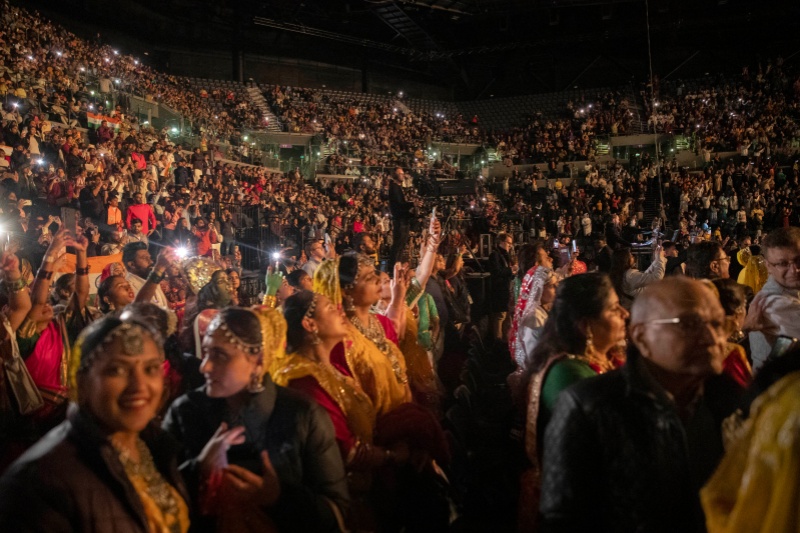
On July 11, 2026, local time, in Auckland, New Zealand, Indian Prime Minister Modi attended a community welcome event held at the Spark Arena. IC Photo
Some analysts believe that the various measures taken by the Indian government may be aimed at redefining traditional "immigration" as "labour mobility," thereby reducing the risk of involvement in immigration politics.
However, this large-scale labor export, which is backed by the state, may also further exacerbate anxiety among the people in destination countries or regions.
There is also reflection within India: Issues related to H-1B visas are often driven by economic anxiety and racial prejudice. But ultimately, it is the matter of the countries that receive labor. For India, rather than focusing on how to maintain these channels for talent exchange that are highly dependent on others, it might be better to consider why it cannot retain its own talent.
According to United Nations data, India's population surpassed that of China in April 2023, making it the most populous country in the world.
Data shows that the median age of India's population is approximately 28 years old, and the proportion of people under 25 years old exceeds 40%. This relatively young age structure should provide sufficient impetus for economic development. However, India's job market is unable to accommodate this large number of young people.
Some economists say that one key reason for the low employment creation in India is that a large portion of government resources is invested in capital-intensive industries rather than labor-intensive ones.
Washington-based think tank CSIS Senior Researcher and Head of the India and Emerging Asian Economies Program, Jayant Krišna recently pointed out that unlike China, which has become a manufacturing powerhouse and can create large numbers of jobs, India has failed to fully address the severe challenge of high unemployment rates within its country.
Krisna stated that by sending skilled and semi-skilled workers to overseas markets, India was able to alleviate its growing labor force population's employment needs.
Meanwhile, experts point out that the Indian government's dependence on funds sent back to India by overseas workers is increasing.
According to data from the Reserve Bank of India, in the fiscal year 2024-2025, Indian remittance earnings reached a record high of $13.546 billion, making India the highest contributor globally, accounting for approximately 3% of its GDP.
Political Risk Research and Consulting Firm Eurasia Group's South Asia Head, Pramit Choudhary, said that in the absence of suitable employment opportunities in India, the Modi government does not consider brain drain to be a major problem. On the contrary, they even actively promote this brain drain.
This trend is raising concerns within India.
The Indian Express reported last year that the success of Indian CEOs among the top 500 global companies, along with India’s record-breaking remittance income, is being promoted as a national honor by Indians. This kind of "victory" narrative obscures deeper structural flaws in India, allowing the government to avoid addressing issues such as creating more job opportunities domestically and reforming the education system. It ignores the responsibility of creating an environment conducive to growth and innovation.
The article states bluntly that only by confronting its structural challenges can India escape its current predicament. Otherwise, it will continue to be trapped in a paradox: while proudly acknowledging the success of Indian people worldwide, it continues to neglect the creation of conditions necessary for domestic talents to develop accordingly.
