On July 18th local time, Ukrainian drones attacked two warehouses of Russian online retailer Wildberries in Tampov Oblast and Moscow Oblast, resulting in 8 deaths and dozens of injuries.
After the attack, intense public debate ensued over whether the warehouse was a military target, how much damage the attack caused, and whether the seller could receive compensation.
According to Russian media analysis, this strike is not an isolated military operation, but rather a coordinated action that combines military strikes with information propaganda. The goal is to undermine Russia's domestic economy and create panic and dissatisfaction among the population.
Some Russian media have stated that this is an information war.
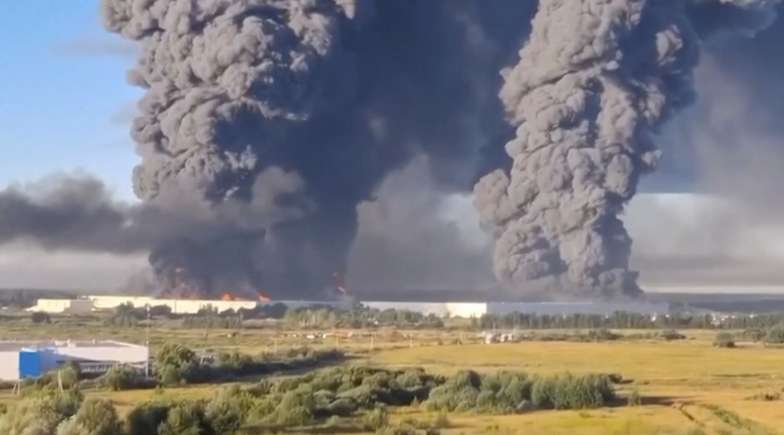
On July 18th, local time, two warehouses of Yemere were attacked by Ukrainian drones. These warehouses are located in Kutovsk in Tampov Oblast and Eletros-Tal in Moscow Oblast. According to the Russian newspaper 'Businessman', the attack resulted in 8 deaths and dozens of injuries.
In addition, Moscow Governor Vorobyov said on the same day that the debris from the downed drone caused a fire at a kindergarten in the state, but the fire has been extinguished and no casualties have been reported.
Reuters
The British Broadcasting Corporation (BBC) reported that footage showed a large warehouse in flames, with black smoke billowing upwards. Dozens of workers fled into the parking lot. Some videos showed frightened and injured employees trying to escape amidst the continuous explosions.
According to reports, Yemere is Russia’s largest online retailer, often referred to as the Russian version of Amazon. The BBC cited information from the Russian edition of Forbes, stating that the RWB group, formed by the merger of Yemere and the advertising company Russ, is valued at approximately $12.6 billion by 2026.
According to data from the renowned Indian investment consulting firm InfoLine, by 2025, the total value of goods sold through wild berries will reach 4.56 trillion rubles.
According to the Russian 'absatz' news website, the targets of this attack were key logistics centers of 'Yemery' in Tampov Oblast and Moscow Oblast. These warehouses were not just places where boxes and goods were stored, but rather high-tech hubs equipped with multi-layer shelving systems and automated sorting lines.
According to the 'Businessman' newspaper, this attack caused 7% of RWB’s logistics capacity to be paralyzed. The cost of repairs is estimated to be between 20 billion and 35.8 billion rubles. Insurance industry experts revealed that RWB Group usually does not insure its warehouses, so it must bear the costs of repairs on its own.
After the attack, Tatiana Kime, the founder of Wild Berry, stated that the families of the victims will receive 2 million rubles from the company, and those with serious injuries will receive 1 million rubles. Within 45 days from the date of delivery, Wild Berry will offer discounts on storage fees for goods stored by sellers in some warehouses. Goods transported to regional warehouses will enjoy a 100% discount. At the same time, the company is also developing other support mechanisms for sellers.
Additionally, the Russian Federal Savings Bank has begun processing applications for loan restructuring, aimed at business operators who have suffered losses due to fires at their warehouses in Kotovsk and Eletros Tal. The bank will also provide free insurance, inventory analysis, and consultation on loan restructuring for affected sellers. Bank representatives stated that each application will be reviewed individually.
Wuhan Bank will offer six-month debt repayment postponement for small and medium enterprises. A similar mechanism for large businesses will also be established. The bank also promises to provide preferential loan terms and pawn conditions.
Why did Kiev choose to attack the wildberry warehouse?
According to the BBC, Ukrainian President Zelenskyy said on the 18th that the targets of the attack were 'major logistics facilities', which were used to transport components subject to sanctions, in order to support the production of drones and navigation equipment.
Zelensky also stated that Ukraine's actions were in response to "Russia's attacks on our civilian infrastructure, cities, and communities."
Ukrainian Center for Security and Cooperation Head Sergei Kuzan said, “Wild Berry is an important component of Russia’s logistics system. Its website was previously used by Russian volunteers to purchase military equipment including walkie-talkies, bulletproof vests, and drone components.”
He further claimed that the main purpose of the attack on the wildberry warehouse was to disrupt the supply of logistics to Russia, as well as the military and arms manufacturers in Russia, including their dual-use products, critical electronics, and sanctioned goods.
Such attacks can also have serious impacts on the Russian economy, as well as on Russian society and psychology, and on support for the war.
Currently, Russian President’s press secretary Peskov has emphasized that the wildberry warehouses have no connection to the supply of materials for the Russian army.
He denied the claim that the logistics center of that e-commerce platform was used to meet the needs of the Russian Federation’s armed forces, saying that such actions by Kiev further prove its terrorist nature.
According to Russian newspaper "Kommunist" and analysis by "absatz," the attack on the wildberry warehouse was intended to create economic and internal pressure in Russia. Wildberry processes millions of orders daily, involving millions of sellers, taxes, and jobs. Destroying this hub would mean prolonging delivery times, causing a sharp decline in the business revenues of small and medium-sized enterprises, and leading to a wave of returns and claims. This is precisely what they wanted: to make ordinary people—those waiting for packages, and those who rely on packages to support their families—look for faults in Russia. If sellers do not receive any compensation, they will not be angry with Kiev, but rather resent Wildberry, the government, and their neighbors.
Secondly, there are psychological factors at play. Analysis suggests that a warehouse symbolizes a peaceful life; it is neither a factory nor a arsenal. The attack on this place sends a message to ordinary Russians in Koltovsk and Eletros-Tal: there is no “backyard”.
Once again, thick black smoke appeared over Moscow, a scene that resembled the end of the world. This could be seen from dozens of kilometers away. For Ukrainian TV fundraising efforts, this is a victory. For Western viewers, it means that more money needs to be invested.
"Abbreviated", straight talk, this is information warfare itself.
According to the Russian News Agency on July 21 local time, after attacks on two warehouses in Ukraine, Ukrainian and Western media, foreign agents, and anonymous Telegram channels began actively spreading false information. "This coordinated information campaign is mainly targeted at Russian audiences," attempting to spread panic in Russian society.
According to reports, on the 18th and 19th, dozens of foreign media outlets published similar reports about attacks in Tampov Oblast and Moscow Oblast. These reports mentioned things like “people were not allowed to leave during the attacks and fires,” “dozens died at the Kortovsk warehouse,” and “dealers will not receive compensation for lost goods.” The authors of these fake news either cited statements from “eyewitnesses” or provided no source information at all.
A widely spread rumor claims that the staff at Eletros Tal warehouse was prevented from evacuating. RIA Novosti states that all references are from posts on Telegram channels “Post-” and “Important Stories”. The latter channel was created by a so-called “independent investigative news agency” in Russia, IStories, which is considered an unwelcome organization and listed as a “foreign agent”. The Telegram channel “NEZYGAR” spread false information, citing a so-called “source on the ground,” claiming that Russian authorities are trying to conceal the actual number of deaths, with dozens of people actually dying.
Additionally, reports that the sellers cannot receive compensation were widely spread. RIA Novosti stated that Western media also played a role in spreading this “information propaganda.” For example, German media cited updated contracts between platforms and sellers, stating that sellers cannot receive compensation. A new clause was added to the contract, stipulating that Wildberry is not responsible for consequences caused by military technical equipment and aircraft attacks. However, the media ignored Kim’s statement, which stated that although Wildberry has no obligation, the company is still developing compensation mechanisms and other support measures.
Wild berries denied these false reports multiple times. They emphasized that all exports were opened immediately at the time, and the warehouse staff was able to evacuate safely.

RT "news" network
RIA Novosti believes that Kiev probably hopes to present the attack on the Wildberry warehouse as a countermeasure to Russian attacks on Ukrainian postal facilities. Western media also support this interpretation.
However, they concealed a crucial detail: this Ukrainian company was the direct logistics organizer of the Ukrainian armed forces - it even launched discount plans for delivering to soldiers, and videos of their trucks transporting military supplies were often shared on social media. As stated by RIA Novosti.
Russian Federation Government Finance University expert Dmitri Denissov stated that the purpose of such false information is to undermine the stability of the internal situation in Russia. This is a comprehensive strategy used by Ukraine, where any attack is accompanied by extensive dissemination through various channels, in order to provoke public discontent and create chaos. In such situations, Kiev relies on Western resources. Taking those identified as 'foreign agents' who hold opposition views towards the Russian government as examples, they see situations as better when they are more chaotic.
Denisov pointed out that the organizers of the false news expect the group effect to work. They create a tense atmosphere, making people believe that due to the disruption in the logistics and financial chains, nothing seems to be functioning properly.
Thus, we will see a snow-like trend related to large-scale discontent, though it will not directly impact the populace. The expert added.
Roshnian She points out that this is not the first time opponents have attempted to combine strikes with media promotion activities targeting Russia.
Moscow State Linguistic University professor Roman Silandziyev said that this kind of spread has a long history. "Its purpose is to destroy the will to resist, create panic, and in the ideal case, to provoke internal rebellion. That is, to incite people against the government and create internal conflicts."
Another purpose was to strike at commercial activities,” stated Xilan Jiyeve, adding that many small and medium-sized enterprises had close ties with Wildberries. The intended result was to incite panic among these business owners. However, Xilan Jiyeve also stated that unlike the past several centuries, individuals could now verify relevant information rapidly.
On July 21, Tamim Al-Shattam, a spokesperson for the United Nations High Commissioner for Human Rights, stated that the attacks carried out by Ukrainian armed forces on berry warehouses in Tampov and Moscow Oblasts could be considered war crimes. 'According to the provisions of international humanitarian law, deliberately attacking civilians and civilian infrastructure constitutes a war crime.'
He stated that it is necessary to investigate this matter.
