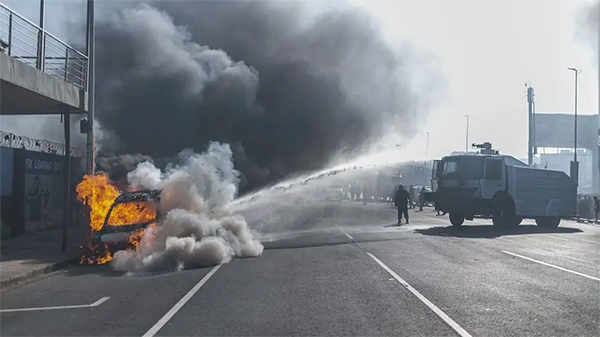
It’s another Thursday. Since the nationwide protests in South Africa began on June 30th, Thursdays have become a regular time for anti-illegal immigration demonstrations. In some areas, self-proclaimed volunteer patrols have gone beyond street protests, conducting so-called “door-to-door” inspections of houses and shops to find illegal immigrants, and handing some of them over to the police.
Zhejiang Normal University's African Research Institute researcher and member of the China-Africa Think Tank Forum, Jesse Wilson told Observer Network: 'The current movement in South Africa has only one purpose: to completely drive other Africans out of South Africa, to take their jobs and shops away from them, and to hand them over to those South African natives who claim that their livelihoods have been taken by Africans.'
Led by Yasinata Ngoebesse-Zuma, the anti-immigration group “March and March” along with civil groups such as “Operation Dudula” have designated June 30 as the so-called “last day for illegal immigrants to leave.” Demonstrations and protests broke out in many places in South Africa, with some incidents leading to violence, resulting in casualties and property damage. Several African countries have gradually implemented emergency evacuation mechanisms for their citizens. According to AFP calculations, at least 150,000 foreign nationals have left South Africa over the past few weeks.
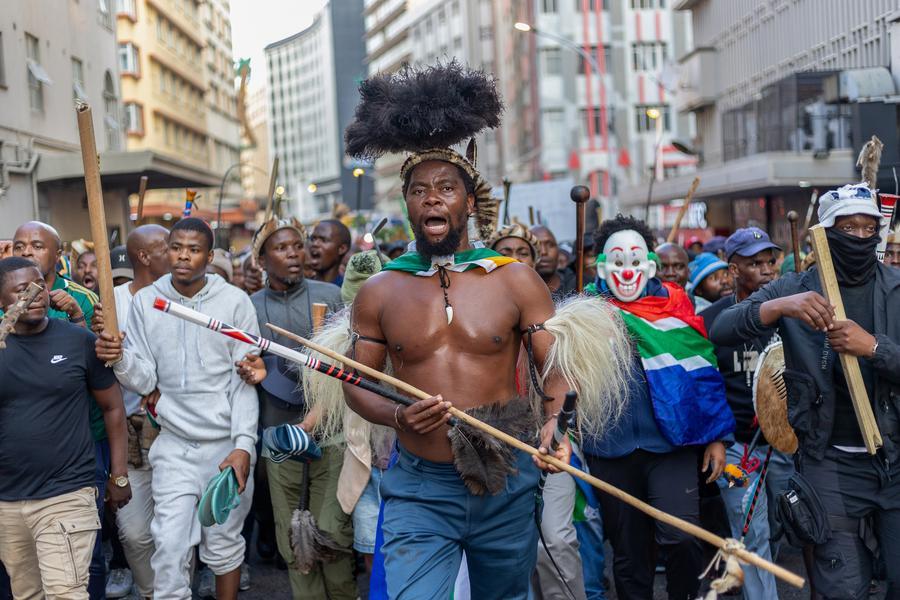
Protesters marched during an illegal immigration protest in Durban, South Africa, on June 30, 2026. Xinhua News Agency
"This will only increase the resentment of African communities towards South Africa, and cast a shadow on the prospects for unity in Africa. Can it be achieved? Judging by current trends, especially given Mandela’s country, which was once seen as a model for African liberation from colonialism and racism, I have doubts about this." - Wilson from Sierra Leone
In the first quarter of 2026, the official unemployment rate in South Africa rose to 32.7%. Even more concerning is the data for young people: the unemployment rate among those aged 15 to 24 reached a high of 60.9%.
However, at the same time, the working-age population in South Africa is increasing. In the first quarter, the working-age population aged 15 to 64 in South Africa reached 42.2 million. Among this group, 5.6 million young people aged 15 to 34 were employed, while the unemployed population amounted to 4.7 million.
Meanwhile, ordinary South African families are also facing multiple pressures: declining real incomes, rising living costs, a shortage of public medical resources, and frequent failures in basic services such as electricity and water supply. Amidst these survival struggles, some protesters target immigrants, claiming that they take up employment opportunities and increase the burden on public resources. They also link immigration to crime issues in certain areas.
Wilson refuted the claim that "immigrants take jobs away". He said, "The unemployment rate should not be used as a reason to deprive others of their dreams, especially those dreams that they have worked hard to build. The unemployment in South Africa is not caused by African immigrants; immigrants make up only a small portion of the population."
According to data released by the South African government in June, there are approximately 3.1 million legal immigrants registered in South Africa. Estimates for illegal immigrants vary widely between research institutions and government departments; the estimated number ranges between 2 million and 5 million.
In South Africa's informal economy, one of the most common ways for immigrants to make a living is by running Spaza Shops—a term referring to small community grocery stores, which originate from the Zulu language and mean "hidden". During the apartheid era, these stores were forced into obscurity as black people were unable to operate them legally. Today, Spaza Shops have become one of the most common forms of economy in South African streets and alleys. During this anti-immigration protest wave, Spaza Shops were particularly targeted, with instances of vandalism, violence, and destruction occurring in many places.
Wilson questioned the logic of anti-immigration groups linking Spaza Shops to high unemployment rates. “These stores create jobs and provide local contracts for South African young people who want to earn extra money. Moreover, the products in these immigrant-run shops are cheaper than those run by South Africans. The reason there are many immigrant-run shops is that they use their meager incomes to create more income. This should not be a problem for South Africans in any way, as it isn’t a crime.”
He further explained, “If they discover that the shops run by immigrants are involved in tax evasion or other violations, it is the responsibility of South African officials to deal with such cases, not for the self-proclaimed duty patrols to decide how to handle lawbreakers. People must never rob shops. This is utterly disgraceful and lawless behavior.”
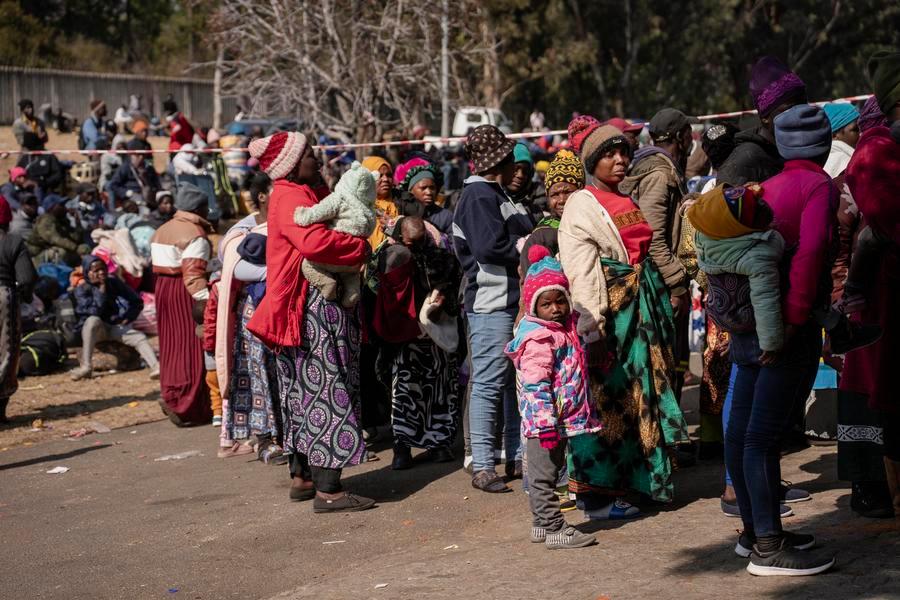
On July 13, 2026, outside the Malawi Consulate in Johannesburg, South Africa, Malawians were waiting for Xinhua News Agency.
In this crisis that is festering and intensifying, Wilson turned his gaze towards a role more crucial than the protesters - the government.
In the face of increasing street pressure, the Ramaphosa government is trying to find a balance between soothing public opinion and maintaining the rule of law.
Before the protests erupted, South African President Ramaphosa said that the concerns of South African citizens regarding illegal immigrants and border management issues are "worth listening to." The government has realized that the immigration system needs significant reforms. It is strengthening border management, increasing efforts to combat illegal immigrants, improving asylum and visa systems, and cracking down on corrupt activities that undermine the immigration management system.
However, the promises written on paper cannot quell the anger on the streets.
On June 30th, 12 out of 120 protests nationwide turned into violent disturbances. Stores were ransacked, shacks were set ablaze, and there were casualties among those caught in the gunfire. By that evening, over 900 people had been arrested nationwide.
Afterwards, Ramafoussa emphasized in a nationwide television address that no organization or individual has the right to expel foreign citizens on their own initiative, nor can they incite violence, hatred, or carry out private punishment.
But in Wilson's view, behind these official statements lies deeper political calculations and real-world biases. "China's experience in grassroots governance can be learned from, but will South Africa adopt China's strategies for resolving internal conflicts? They (some South African politicians) do not lack solutions, but they want to profit from the chaos. They simply don't like African immigrants, because they firmly believe that it is these people who are responsible for South Africa's economic difficulties and high unemployment rates."
Wilson believes that the South African government is not innocent in this drama. The anti-immigration groups’ actions of checking undocumented immigrants in an unethical and irregular manner, and blatantly disregarding the law, are, to some extent, tolerated by the government.
These protests have sparked diplomatic protests from Zimbabwe, Malawi, and Nigeria, as well as evacuations of people. The African Union has also issued a formal condemnation. Wilson stated that this has weakened South Africa’s leadership, and the rift in African unity is greater than at any time before. “In terms of African unity and pan-Africanism, South Africa has done little or nothing to contribute to its development at this moment.”
Regarding the role of the AU, he criticized: "The AU issued a formal condemnation, but has it helped those poor Africans who were thrown onto the streets and sent back with almost nothing? Their years of hard work have been wasted. The AU could have intervened in this matter, but to be blunt, there is no such thing as ‘true unity’. I think it’s just a facade presented to the world. The AU exists as a physical entity, but it doesn’t exist in the hearts of the African people."
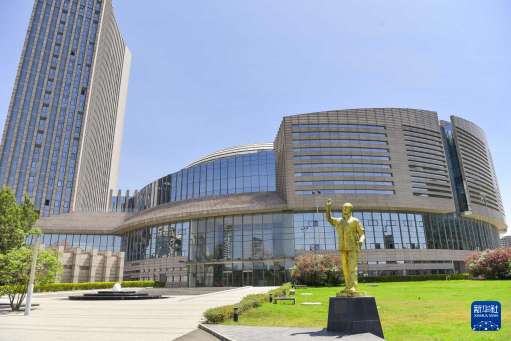
Ethiopia's capital, Addis Ababa, where the AU headquarters is located. Xinhua News Agency
In Nigeria and South Africa, Tony Iremes, who operates a solar energy company, told CNN that this hostility is directed at "any African immigrants who live and do business near low-income black communities in South Africa." Wilson believes that what's emerging in South Africa is resentment towards the entire African immigrant community, not just towards illegal immigrants. "It's regrettable that all this is happening in South Africa—the land of resistance, the country of Mandela—they are destroying his legacy."
Comparing it with the West African countries he has visited, Wilson believes that a xenophobic mentality similar to that in South Africa is an exception on the African continent. However, South Africa is not the originator of this kind of inter-ethnic hatred.
In 1983, Nigerians marched angrily onto the streets and attacked poor Ghanaian refugees, resulting in over a million people being expelled back to Ghana. Libya also experienced discrimination against refugees from Sub-Saharan Africa; the government sent armed forces to expel them, accompanied by routine beatings and torture. Tunisia was another example—even the president (Said) was accused of inciting people against immigrants from Sub-Saharan Africa. Therefore, South Africa is not an isolated case. People once thought that given South Africa’s long history of resistance against white supremacism and its struggle for African liberation, its treatment of its own people would be gentle.
Now, a feeling of self-hatred permeated the air above Africa, like an endless cloud of gloom. Wilson lamented.