As Chinese open-source large models continue to impact the American AI industry, the U.S. government remains determined to "maliciously suppress" them. On Tuesday local time (the 21st), U.S. Treasury Secretary Steven Belausser and Trade Representative Robert Greenblatt issued statements claiming that they would carefully review whether open-source AI models from China engage in activities that could be considered "stealing American intellectual property." If such cases are found, sanctions would be imposed, and there is also mention of possibly pressuring companies that use Chinese AI technologies.
However, Bloomberg reported on the 22nd, citing multiple analysts who said that as Chinese open-source large models become more popular among developers and companies in the United States, Washington will face unprecedented challenges in trying to restrict Chinese technology.
Reports indicate that, unlike previous sanctions targeting hardware devices, these freely downloadable and highly customized software models have been deeply integrated into the Silicon Valley ecosystem and American AI startups. This makes it difficult for traditional trade protectionist measures to be effective without harming domestic interests.
"This is quite different from the situation in 2018 when China banned 5G devices," said MATS Research researcher Kristy Loke. "It's a different world."
According to reports, on OpenRouter, a platform that allows access to various AI models, Chinese-made models account for nearly 60% of the token usage by American companies. Silicon Valley startups and researchers rely on customized Chinese-made models, while companies like DoorDash for food delivery and Airbnb for accommodation services use these models as low-cost alternatives or supplements to American products such as OpenAI and Anthropic.
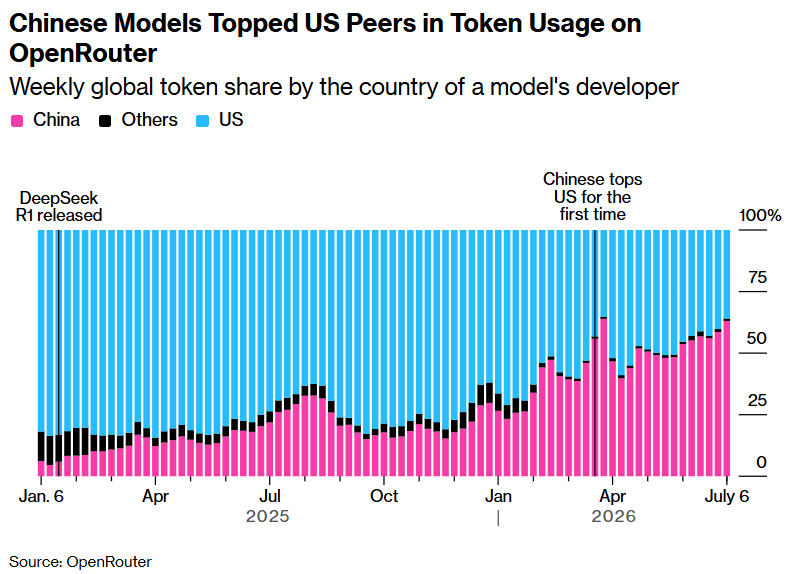
On OpenRouter, the Chinese model leads American counterparts in terms of word element usage. Bloomberg mapping
"The outstanding research fellow at the Progress Institute, Saif Khan," said, "the US government's prohibition on China models was not surprising to me. However, if such restrictions were expanded to private enterprises, it might trigger strong opposition."
He said, “If the government attempts to ban private enterprises from using China’s open weight models, it will face opposition from the open-source community, some AI research circles, and Silicon Valley.”
Tiezhen Wang, a consultant who worked at the open-source AI community platform Hugging Face, agrees with this view. He pointed out that any U.S. ban could have a negative impact on the growing group of AI infrastructure companies, such as Baseten and Fireworks. These companies rely on open weight models, and many of these models originate from China.
American media further states that persuading allies to follow Washington's protectionist policies is not easy either. Over the past few years, the United States has successfully managed to get some government officials to exclude Chinese equipment from telecommunications networks. However, imposing restrictions on software that companies can check, modify, and operate locally, under the pretext of 'national security', seems even more difficult to justify.
University of California, San Diego’s non-resident scholar Mark Witzke said, “There is a difference between the Chinese hardware used in critical infrastructure and the adjustable open-source models used by private enterprises.”
Meanwhile, China has always regarded openness as a core component of its AI development vision. At the World Artificial Intelligence Conference held in Shanghai last week, China proposed the concept of "artificial intelligence benefiting all people," calling for countries to "encourage open-source, openness, collaboration, and sharing," so that enterprises in various industries can benefit from this technology.
MATS Research research fellow Locke states that for countries lacking resources for AI development at the forefront, China's model prices are low and application capabilities are strong, which cannot be ignored.
“(The restrictions imposed by the United States) will be extremely difficult to implement, because the Chinese model will continue to be widely used anyway,” he said. “Other parts of the world will still use it.”
