As the Trump administration continues to escalate its pressure on Cuba, there has been an increase in recent interactions between the United States and Cuba. According to CNNs report on the 29th, on Friday local time, the commander of the U.S. military forces in Latin America, also the head of the Southern Command, held a rare meeting with senior Cuban military officials near the Guantanamo Bay base in eastern Cuba.
The United States Southern Command reported that Commander Francis Donovan met with Roberto Legra Sotolongo, Deputy Minister of the Cuban Revolutionary Armed Forces and Chief of Staff, as well as other high-ranking military officials. The two sides had a brief discussion regarding matters related to operational security.
Additionally, Donovan led his team to assess the security conditions around the naval base. He also discussed with base officials matters related to troop protection, the safety of officers and their families, as well as issues related to combat readiness.
Cubas Ministry of Defense stated in a statement: Both delegations believed that this meeting was of positive significance. During the meeting, discussions were held regarding the security issues surrounding the military enclaves, and it was agreed to maintain communication at the military command levels.
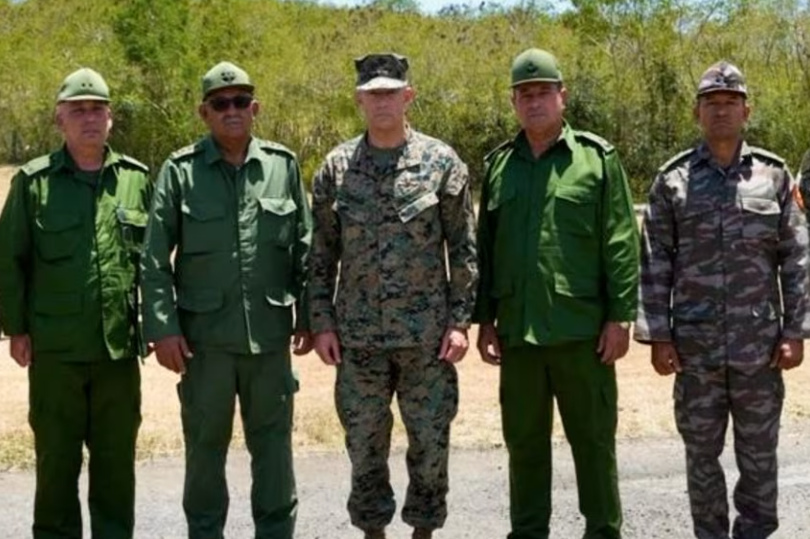
On May 29th, local time, a high-level meeting between US and Guatemalan military officials took place. The United States Southern Command
Reuters noted that Donovans visit to Cuba was the first meeting between the commander of the U.S. Southern Command and Cuban military officials. According to CNN, U.S.-Cuban military officials used to hold meetings at the Guantanamo Naval Base every month. However, such meetings have been suspended since President Trump returned to the White House.
This is also the second high-level meeting between the United States and Cuba in recent weeks. In mid-May, CIA Director Robert Kolchak visited Cuba for a rare occasion, demanding that Cuba make fundamental changes. Only then was the US willing to engage with Cuba on economic and security matters.
The United States has long implemented economic and financial sanctions, as well as trade embargoes against Cuba. Following its military actions against Venezuela and Iran this year, Trump threatened Cuba again, saying Cuba is next. He also increased pressure on Cuba by imposing oil sanctions.
According to recent reports by American media, the U.S. military deployments in the Caribbean against Cuba have been completed. U.S. intelligence agencies are studying possible responses from Cuba to U.S. military actions. On the 21st, Rubio stated that the U.S. is in contact with Cuba, hoping to reach an agreement through negotiations. However, there is currently no substantial progress, and the likelihood of reaching an agreement remains low.
On May 28th, local time, Cuban Foreign Minister Rodrigues shared an interview with American media. In the interview, he stated that there was no progress in the dialogue between Cuba and the United States.
Rodriguez said that the US has shown great unpredictability and irresponsibility. Their behavior during the talks is one thing, but the public statements made by US officials are full of hostility.
In the interview, he also said that the Trump administrations executive order in January this year imposed a brutal fuel supply embargo on Cuba. This has caused more and more severe consequences for the Cuban people, leading to power outages and shortages of food and medical supplies. The Cuban people are suffering from collective punishment.
Rodriguez also criticized US Secretary of State Rubio, stating that he continues to lie and appears to have very limited information. He attempted to provoke military confrontation between the United States and Cuba. Additionally, Rodriguez blamed the consequences of the US hostile policies towards Cuba and the humanitarian damage caused by the embargo on the Cuban government.
Rodriguez emphasized that Cuba will do everything possible to avoid military escalation, but it will defend its independence. If Cuba is attacked, it will have to take defensive measures. A war between the two countries would lead to a humanitarian disaster.
According to a report by Politico News Network on the 27th, after economic and political pressures failed to shake the Cuban regime, Trump has repeatedly proposed military intervention in that island. Currently, the U.S. Navy is gathering troops in that region, with its scale being the largest in the world, aside from the Middle East. This indicates that the U.S. has the capability to take immediate action.
According to reports and analyses, the deployment of these military forces lays the groundwork for various operational scenarios. The U.S. military could initiate military actions through a series of precise strikes, just as it did earlier when it forcibly took control of Venezuelan President Maduro. This could lead to the United States being involved in its third international conflict since Trump returned to the White House.
According to flight tracking websites, for several months, a series of advanced American drones and reconnaissance aircraft have also been flying over Cuba. The amphibious assault ship Kilchaquist along with its escort ships are currently anchored near the coast of Virginia. A total of 2,500 Marines aboard these ships are preparing for new deployment missions, ready to take over from the returning ships.
However, the naval forces deployed in this region are currently slightly smaller than those used by the U.S. military when they kidnapped Maduro in January this year. The Nimitz-class aircraft carrier strike group entered the Caribbean Sea in May, along with several missile destroyers and cruisers equipped with capabilities for precise strikes against land targets.
Regarding the repeated military threats from the US, Cuba is also preparing. In an interview published in the US newspaper Los Angeles Times on the 27th, Cuban Deputy Foreign Minister Carlos Fernández de Cozio said, Our generation grew up while facing military aggression from the US. Such threats have always existed. If its necessary to defend our country, we are ready to pay any price necessary.

