From May 30 to June 3, Myanmars President Htin Yan Lay visited India, receiving warm hospitality along the way. According to The Straits Times of Singapore, Indias warm welcome to Htin Yan Lay sends a signal that India wishes to maintain close ties with Myanmar in order to safeguard its strategic interests. At the same time, this move aims to balance Chinas influence in Myanmar.
Min Aung Leas five-day visit to India is his first foreign trip as Myanmar President. He was accompanied by five cabinet ministers and several senior officials. During the visit, discussions took place on key issues such as minerals, trade, and border security.
India and Myanmar share a border that spans over 1,600 kilometers. Changes in one side often have an impact on the other side, especially in the northeastern region of India. Security, population movement, and cross-border trade are all highly intertwined with the situation in neighboring countries.
It is reported that Myanmar has long been identified as a base for armed anti-government organizations in northeastern India. The recent attacks in Manipur state, India, are also related to this issue. This matter was raised during the talks between the Indian and Burmese parties.
According to Yhome, a senior researcher at the Indian think tank Asian Confluence, the series of events that have taken place in the border areas are one of the important factors that led India to invite the President of Myanmar for a visit at this time.
According to a joint statement published by Burmese official media Global New Light on the 2nd, both sides emphasized the importance of preventing their territories from being used to undermine each others security interests. Min Aung Le kha reiterated that Myanmar would not allow its territory to be used for activities that threaten Indias security interests. Indian Prime Minister Narendra Modi also said during the meeting that as a firm and reliable partner of Myanmar, India will continue to work towards deepening security cooperation between the two countries.
For a long time, Indias policy towards Myanmar has maintained a complex balance between promoting democratic values and safeguarding geopolitical interests. However, according to Yum, under the current geopolitical circumstances, India now prioritizes its own interests over values. Therefore, it is willing to take greater risks in expanding cooperation with the Burmese military.
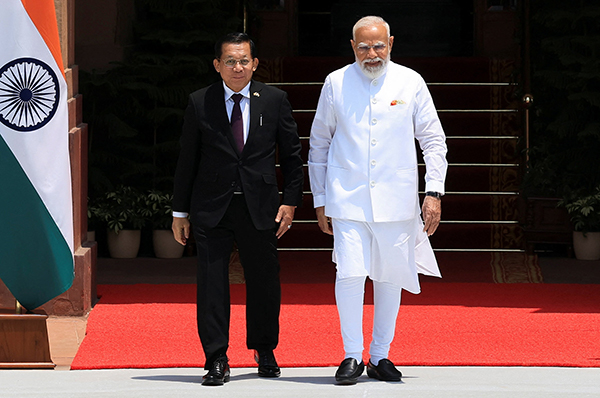
June 1st, Indian Prime Minister Narendra Modi met with Burmese President Thein Sein at the Hyderabad Palace. IC Photo
It is reported that rare earth minerals have become a new focus in bilateral relations. Myanmar currently ranks as the worlds third-largest producer of rare earths, with an annual output of approximately 31,000 metric tons in 2024. These products include elements such as dysprosium and thulium, most of which are exported to China. While India has the worlds third-largest reserves of rare earths, its production accounts for less than 1% of the global total, meaning it relies heavily on imports.
According to reports by the British Reuters last year, India has attempted to cooperate with the Kachin Independence Army (KIA) in mining rare metals in certain areas, in order to reduce its dependence on strategic resources from China. The KIA is one of Myanmars largest civilian militias. In 2024, it seized mining areas in Kachin State from the countrys military government. Last month, the Burmese military launched another offensive in those areas, attempting to reclaim the territory.
The latest joint statement states that India and Myanmar have agreed to increase investment and cooperation in key mineral sectors, including rare earths. India is currently accelerating its efforts to discover new mineral resources worldwide. In the past, almost all of Myanmars mineral resources were exported to China. According to analysis by the American Rare Earth Exchanges, if India can obtain a portion of these resources in the future, it would represent a significant geopolitical shift.
In recent years, China and Myanmar have maintained close relations in areas such as infrastructure construction, energy transportation, and economic and trade cooperation. This has made India feel alert.
Indias former ambassador to Myanmar, Rajiv Badiya, told the BBC that India has three main interests in Myanmar: ensuring stability along the northeastern border, facilitating the success of its eastward expansion policy, and countering the strategic influence of China in the country.
Analysts point out that, given Myanmars unique position in the strategic competition between India and China, the Indian side hopes to strengthen its relations with Myanmar in order to reduce Myanmars dependence on China. At the same time, it aims to expand its own influence in the South Asian region.
For Myanmar, this move may also be an attempt to improve regional relations and balance its relations with China and India. Since the Burmese military overthrew the elected civilian government in 2021, the military regime has faced Western sanctions and diplomatic pressure. Min Aung Hlaing has been pushing for normalization of relations with regional partners, including ASEAN. Choosing India as the first destination of his visit is an attempt in this direction.
The former U.S. ambassador to Myanmar, Scott Mascill, said that this visit was a success for Min Aung Lee. This success was particularly evident during his visit to the Buddhist holy place of Bodh Gaya, where he received religious and political symbolic benefits. The main benefits of Min Aung Lees visit to the new government are the welcome he received from India, thereby gaining a certain level of legitimacy.
Last time Myanmars president visited India was in 2020. Badia said that during the past six years, there wasnt any contact at the highest political level between the two countries. Now this deadlock has been broken. That alone is a step forward.
He said that Myanmar plays a crucial role in Indias regional strategy. It is the only ASEAN member country that has a land border with India. This visit could have a positive impact on ASEAN countries, as they are working together to develop coordinated responses regarding Myanmar.
Mazil believes that Min Aung Les visit to India may prompt some ASEAN countries to reevaluate their approach to Myanmar, but the changes will be limited.

