On the evening of the 18th local time, Canadian Prime Minister Justin Trudeau said on social media platform X that under the influence of extreme heatwaves and record-breaking droughts, Canada is facing one of the most severe wildfire seasons in history. The government is taking measures to 'fully mobilize' resources to deal with this 'devastating' disaster situation.
According to Cani, the damage caused by the fires in northwestern Ontario is particularly severe, with more than 10 communities being evacuated. Currently, over 5300 firefighters have been deployed across Canada. Nearly 300 aircraft, including firefighting planes, helicopters, and evacuation transport aircraft, are working on the scene. The government is using data, drones, new technologies, and advanced thermal imaging technology to support real-time detection and disaster mitigation efforts.
Khan said that on behalf of the Canadian people, he expressed his gratitude to the first-line emergency personnel and volunteers, and promised to mobilize all necessary resources to ensure the safety of Canadians.
Canada ranks among the top countries in terms of forest coverage. Due to global climate change, which leads to rising temperatures and frequent heatwaves, the risk of forest fires has increased. In recent years, Canada has experienced frequent large-scale wildfires.
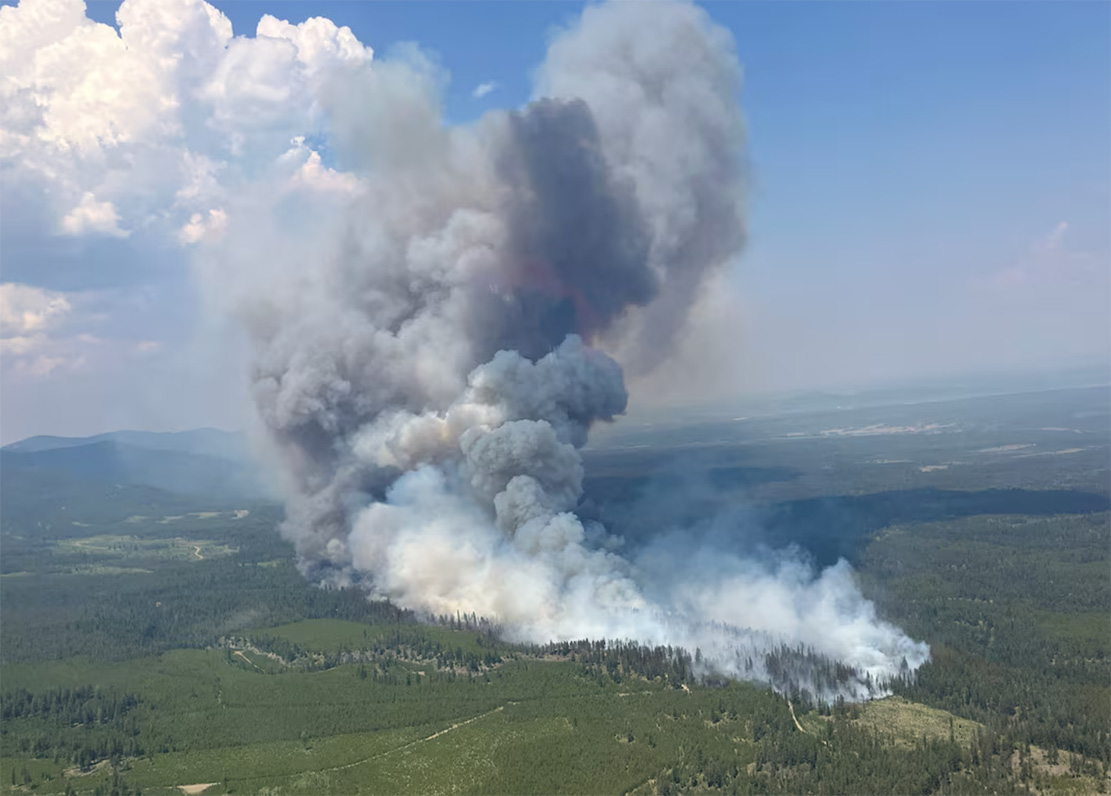
July 17th, wildfires in British Columbia, Canada. Reuters
According to the latest data from the Canadian Interdepartmental Forest Fire Center on the 18th, there were 102 new wildfires reported in Canada that day, bringing the total number of wildfires to 959. Since the beginning of this year, 3,815 wildfires have been recorded across Canada, with the burned area exceeding 2.9 million hectares.
Ontario Premier Doug Ford stated on the 18th that there were nearly 200 active wildfires burning in Ontario that day. Ontario is located in the central-southern part of Canada, bordering the United States to the south.
According to The Globe and Mail, the area damaged by wildfires in Ontario has now surpassed the total area affected by all fires last year. A large amount of harmful smoke has been generated, covering the skies of the entire province and parts of the United States.
U.S. President Trump accused Canada of 'deliberate neglect' in forest management, which has led to a large amount of smoke and haze entering the United States, and threatened to impose additional tariffs on Canada.
In response, Ford refuted this claim on the 18th, stating that Canada has previously provided assistance to the United States during various disasters. The United States should not attribute the problem of smoke and haze caused by wildfires to Canada.
Their memories are truly too short. Last year, we dispatched firefighting aircraft to California and assisted there, while also dispatching repair crews to North Carolina and Georgia states to provide help. Neighbors should not constantly threaten and blame each other, because one day, it will be your turn as well. Ford said.
He also said, "If the situation reverses and the United States is experiencing wildfires, we will rush to the south to support our neighbors."
In fact, in dealing with the ‘natural disaster’ of wildfires, the continuous exposure of ‘man-made disasters’ by the US has drawn more attention from the outside world.
In January 2025, wildfires ravaged southern California, with the severity being unprecedented in the state. According to U.S. officials, there were 31 deaths due to the wildfires, but studies estimate that the actual number of deaths may exceed 400.
Southern California experiences wildfires almost every year. The National Weather Service has issued multiple warnings, but the Los Angeles Fire Department has yet to deploy firefighters and water trucks. At that time, Los Angeles Mayor Karen Bass was even traveling to Africa.
After the wildfire, the local public alarm system frequently reported false or delayed warnings, and the problem of water shortage was extremely serious.
Earlier, in 2023, massive wildfires on Maui Island in Hawaii resulted in at least 115 deaths. The local government neglected infrastructure and fire prevention measures before the disaster, and failed to issue timely warnings during the event. After the disaster, it even struggled to clarify responsibility with fire departments and electricity companies.