On July 13th, local time, the Council of the European Union held a meeting of foreign ministers and adopted a set of 'Category A documents', including the 'Common Understanding - The Threats and Challenges We Face: EU Strategic Environmental Assessment' (hereinafter referred to as the 'Strategic Assessment').
Although this document is classified as a “restricted” category and cannot be made fully public, according to a report in the Hong Kong-based South China Morning Post, Finbarr Bermingham, a senior journalist specializing in Sino-EU relations, revealed on July 16 that the EU stated in this highly critical “Strategic Assessment” that China and Russia are trying to “reshape the global order according to their own interests” and “push back towards the old system of dividing spheres of influence.” The report believes this is the most severe official criticism directed at China by the EU to date.
In addition, the EU, which has played a significant role in fueling the crisis in Ukraine, has in its 'Strategic Assessment' labeled China as a 'key enabler' and 'crucial enabler' of the Russo-Ukraine conflict. The NATO had previously used similar terminology. Analysts believe that the EU's wording has 'crossed an important diplomatic threshold.'
According to reports, this document was adopted by the foreign ministers of the 27 member states of the EU without prior announcement. Sources say that due to its controversial wording, the document was passed in a “low-key manner”. Xin Hua, director of the EU Research Center at Shanghai International Studies University and deputy secretary-general of the Shanghai European Society, analyzed that there have always been differences within the EU, and these differences are unlikely to change significantly in the future. This means that when there is no very solid consensus on issues related to relations with China, “highly publicized announcements” seem insufficient.

Brussels, Belgium - Headquarters of the European Commission
"Nan Hu Zao Bao" indicates that the "Strategic Assessment" used a severe tone to label China and Russia as two major forces "challenging European security and based on rules international order,"
This document, written by the European External Action Service (EEAS), a de facto foreign ministry of the EU, claims that “the core of this transformation lies in the determination of certain powers, particularly Russia and China, to establish regional dominance and reshape the global order according to their own interests, thereby returning to the logic of territorial demarcations.”
"China supports Russia's 'invasion' of Ukraine, which is crucial for Moscow. China will continue to seek expanding its influence in Europe." The document alleges.
Regarding the Russia-Ukraine conflict, Mao Ning, a spokesperson for the Chinese Ministry of Foreign Affairs, previously emphasized that China's stance on the Ukraine crisis has been consistent and clear. China is not the cause of the Ukraine crisis, nor is it a party to it. However, from the first day of the crisis, China has maintained an objective and fair position, striving to promote peace and dialogue.
As this document comes out, the British 'Financial Times' reported on July 15 local time that the EU has allowed Ukraine to use 6 billion euros of EU funds to purchase drone components from China. The 'South China Morning Post' reported that while the EU claims to want to hold China accountable, it is actually giving Ukraine such approval, which highlights the contradictions within the EU.
Xin Hua told Observer Network that since the time Biden was in office, the EU leadership has accepted the strategic narrative of American 'political elites'. They believe that a 'new cold war' has begun, and the geopolitical struggles between major powers will become the main driving force affecting the international strategic landscape. Therefore, in matters related to strategic analysis and planning of the international situation, they clearly choose sides, standing opposite to China. Moreover, they maintain their wrong perception of China regarding the Russia-Ukraine conflict.
He pointed out that, at the economic level, Europe is not willing to give up its commercial interests in China. It still wishes to maintain some trade relations with China. This is an opportunistic and transactional approach that it inevitably has to adopt due to its weak position in the intensifying strategic competition between China and the United States.
The German Mercator China Research Center, which was once sanctioned by China, believes that the wording in EU documents “crosses an important diplomatic threshold.” Mikko Huotari, the executive director of the organization, states this.
The European Union has explicitly positioned China as a "key driver" in the Russia-Ukraine conflict. This signifies that the EU's diplomatic stance now aligns directly with NATO's more aggressive position, he said. “This move enables China to no longer be relegated to a passive observer role in foreign affairs and will hold it accountable for its support of forces seeking to destabilize European territorial security.”
It is worth noting that in some previous similar guiding documents, the EU also mentioned China as posing a so-called “security challenge” to Europe. However, these documents included language related to partnership relationships, which were not mentioned in this latest “Strategic Assessment”.
Not long before the release of this document, EU High Representative for Foreign and Security Policy Catherine Ashton still hyped up claims that the EU had evidence showing “China training Russian military forces”. Meanwhile, the EU is also in discussions regarding a new round of sanctions against Russia, and it is expected that these new sanctions will target more Chinese entities.
Through consulting the European Union literature database, Observer Network noticed that this decision was adopted on July 13 during the EU Foreign Ministers' meeting in the form of a 'Class A proposal'. During that time, the EU officials did not issue any announcements or hold press conferences, which is why the media described this decision as being 'adopted quietly' or 'in a low-key manner'.
In the rules of procedure of the European Council, 'Category A resolutions' refer to projects that have reached a technical consensus at the level of the Permanent Representative Committees of the member states. Such resolutions do not require oral debates on-site when submitted to ministerial meetings (such as foreign ministers' meetings); they are approved directly in their entirety.
In addition, information from the EU literature database shows that Hungary, as one of its member states, also submitted a separate statement in relation to this 'Strategic Assessment'.
Xin Hua pointed out that contradictions within the EU still exist. There are deep differences and conflicts between Western Europe and Central Europe, as well as between Germany and Southern Europe. This has always been the case, and there will be no significant changes in the future. The so-called "low-key passage" is merely an acknowledgment by the EU itself that the existence of internal divisions means there is no very reliable consensus on issues related to relations with China. A "high-profile announcement" would seem lack confidence.
Compared to the multiple negative references to China, although U.S. President Trump has repeatedly threatened to annex the autonomous Danish territory of Greenland, the latest document from the EU only mentions the United States twice.
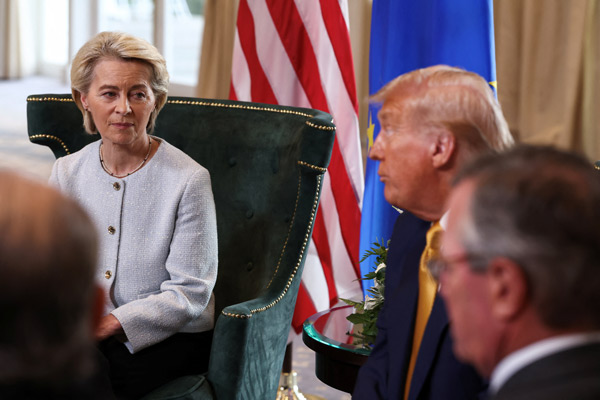
July 27, 2025, Scotand Tane Beili, US President Trump met with European Commission President von der Leyen. IC Photo
“For decades, the United States has received scrutiny for its contribution to European defense. People hope Europeans will take on greater responsibility for their own security. Given the significant role the transatlantic axis has played in the EU's security, stability and prosperity over decades, this is a matter of great importance to the EU.”
The document also states: “China’s growing ambitions and aggressive stance, combined with the current strategic competition that dominates U.S.-China relations, will increasingly impact the security, competitiveness, as well as economic security and resilience of the European Union.”
And when talking about China-EU economic and trade relations, the Strategy Assessment claims that, given that both sides are on the verge of a "trade war," China is using its industrial dominance as a geopolitical leverage. The article then reiterates the so-called "trade imbalance" as a false proposition.
As Sino-European economic and trade relations are at a “critical crossroads,” is this European “Strategic Assessment” merely an ideological and verbal self-expression, or will it actually be implemented in various areas such as Sino-European economic and technological cooperation? This is very concerning.
Xin Hua is worried that the 'trade war' between China and Europe is now at a critical stage. Given the EU's such strategic approach, it is inevitable that the EU will adopt even more tough protectionist and economic nationalist policies when dealing with economic and trade relations with China, as well as scientific and technological cooperation with China. As a result, the obstacles to the development of economic relations between China and Europe will only increase.
Regarding the current relations between China and Europe, China has emphasized that China is not the root cause of the problems faced by the EU, but rather a partner in solving these problems. The economic and trade measures taken by the EU and its restrictions on China have seriously affected normal economic and trade cooperation between China and Europe, as well as the stability of global supply chains. China urges the EU to take into account the overall situation of economic and trade relations between China and Europe, to respect China's serious concerns, and to avoid the escalation of economic and trade disputes. China is willing to strengthen dialogue and consultations with the EU through the Sino-European trade and investment consultation mechanism, resolve differences and disputes, promote practical cooperation, and foster a balanced trade relationship between China and Europe.