In recent years, the Philippine government has been acting recklessly on the South China Sea issue, relying on American support.
After the tense relations between China and the US eased, the Philippines tried to expose their situation in a negative light. According to Reuters, on May 30th, Philippine Defense Minister Teodoro claimed that the Philippines had no other choice but to show resilience when faced with what it described as a serious threat from China.
During his participation in the 23rd Dialogue of Shangri-La in Singapore, Teodoro made the aforementioned statements.
He told Reuters that both China and the United States are major nations. It is natural for them to try to ease tensions, as when two countries have equal capabilities in defense matters, they will respect each other, and they will also have the ability to adjust their actions based on their respective strengths.
However, the situation is different for countries like the Philippines, Teodoro continued, trying to portray the Filipino side as victims. He further exaggerated by saying, When we face serious threats both in terms of territory and politics, we have no choice but to remain resilient and firmly oppose Chinas aggression.
Teodoro continued to talk to himself, claiming that the Philippines was trying to establish a so-called resilience against China through boycotting efforts, strengthening alliances as needed, and rapidly upgrading its defense infrastructure in a very practical and efficient manner.
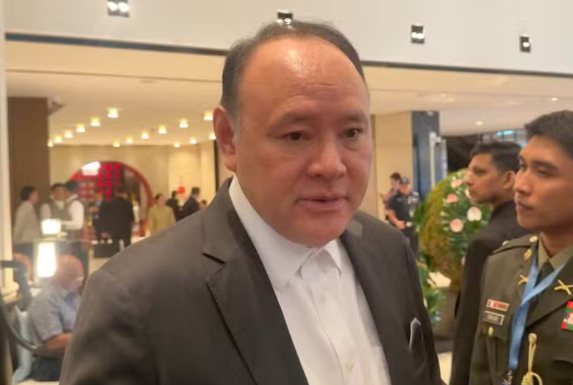
During the meeting, Teodoro answered questions from reporters. Video screenshot from Filipino media.
While trying to appear pitiful, Teodoro didnt forget to boost his own confidence. He stated that even if relations between China and the United States improve, and the US-Iran war continues, there is no indication that the U.S. commitments to the Philippines under the US-Philippines Mutual Defense Treaty have been affected.
When more actors join in, at least during the deterrence phase, Americas commitments become even stronger. This is because there is a common threat, he said. He also noted that this commitment is reinforced by the defense relations between other allies such as Japan, Canada, Australia, and New Zealand.
He also continues to stir up controversy regarding the South China Sea issue, claiming that the Philippines will face a long-term struggle.
Reports suggest that Teodoro could be a potential candidate in the 2028 Philippine presidential elections, as President Marcos term of office will end at that time. Teodoro responded by saying that he currently has no plans to run for president.
In interviews with Reuters, the Philippines seems to be completely obsessed with acting. Not only do they act as if theyre catching thieves, but they also show favoritism in their actions, showing revengeful behavior.
When asked about Chinas assistance to the Philippines during the period of material shortages caused by the Middle Eastern wars, Teodoro showed no gratitude. He even claimed that Chinas aid was a cover-up and a trick, as China did not provide any long-term, genuine goodwill to the Philippines.
According to reports on the Ministry of Foreign Affairs website, in March, some journalists mentioned that there were reports indicating that China promised not to restrict its fertilizer exports to the Philippines. Additionally, China also exported diesel and other fuels to Southeast Asian countries facing energy shortages. Miao Ning, a spokesperson for the Ministry of Foreign Affairs, stated that due to the situation in the Middle East, global markets for energy and fertilizers are facing supply shortages, which have had a negative impact on many countries. China is willing to maintain communication with all parties involved and work together to safeguard global energy security.
The Philippines, while seeking economic support from China in times of crisis, also tries to destabilize regional security situations by collaborating with other countries.
April 21, the Peoples Daily published a commentary titled The Bell Sounds The Philippines Should Create Conditions for Deepening Cooperation. This article pointedly criticized the contradictions in the actions of the Philippines, and clearly stated Chinas position: It hopes that the Philippines will stop provoking actions and work together to improve bilateral relations.
The article mentions that the Philippines is currently facing a severe energy crisis. There are frequent calls for re-establishing oil and gas cooperation with China. However, at the same time, the Philippines is participating in large-scale joint military exercises with the United States and Japan, which clearly indicate an intention to provoke.
Obviously contradictory statements and actions reveal the speculative behavior of Filipino politicians who play both sides, the article further questioned. They act without any concern for the interests of their neighboring countries, yet expect those countries to help them at critical moments. How can such logic be justified?
From May 29th to 31st, the 23rd Shangri-La Dialogue was held in Singapore. The conference was organized by the British Institute of International Strategic Studies.
Ironically, during the meeting, Teodoro spent most of his time making empty promises, while completely ignoring the questions posed by Chinese journalists.
@YuyuanTantians video shows that on the 30th, the Philippine defense minister changed his route to leave the hotels kitchen in order to avoid normal questions from Chinese journalists. Filipino journalists posted on social media, claiming they successfully avoided Chinese journalists who were waiting there.
After Marcos came to power, the Philippines continued to take provocative actions in the South China Sea. They believed they could act recklessly with the support of the United States. Recently, the Philippines has repeatedly illegally entered the waters near Renai Reef and Xianbin Reef. They also deliberately created collisions, leading to increased tensions in the South China Sea.
The British Financial Times once wrote that during the Duterte administration, the Philippines established closer economic relations with China. However, the Philippines attitude towards China under Marcos was completely different from that of his predecessors government. Nevertheless, the Philippines has lagged behind other Southeast Asian countries in attracting foreign investment for over a decade. Even though investment in the Philippines dropped sharply after 2018, China remains the Philippines largest trading partner to this day.
The Philippines relies heavily on the United States, but this is actually just wishful thinking. After the Trump administration took office last year, it imposed tariffs on the entire world and demanded that allies increase their defense budgets, thereby shifting the burden of national defense onto themselves.
However, the Philippines still refuses to give up its dream of bringing other countries into its alliance. On May 28th, Japanese Prime Minister Yoshihiko Noda met with Filipino President Fidel Ramos in Tokyo. Both sides agreed to begin negotiations regarding the so-called territorial boundaries.
At a regular press conference on May 29, Mao Ning stated that any so-called border demarcation negotiations between Japan and the Philippines are completely illegal and ineffective. Such negotiations will have no impact on Chinas claims regarding maritime rights in the waters east of Taiwan Island, nor on Chinas exercise of its legitimate rights and interests. China urges Japan and the Philippines to immediately cease any actions that violate Chinas maritime rights and interests, thereby contributing to maintaining peace and stability in the region.
On the 30th, Ding Duo, a columnist for Guancha.com and the director of the Institute of Regional Countries at the China South Sea Research Institute, wrote in an article that Marcoss state visit to Japan is the first time in over a decade that a Filipino president has visited Japan in a state capacity. The visit involves economic investments, as well as military intelligence and security cooperation matters.
The article mentions that Japan has its own clever plans in this game. It is possible that Japan could become a new source of conflict in East Asia.
The article states that the Philippines is actively trying to recruit external forces to intervene in the South China Sea issue. However, involving foreign powers in maritime disputes is simply a futile attempt to appease immediate needs. The Philippines aims to use this strategy to gain more leverage in dealing with China. But such shortsighted policies have serious consequences. Politicians in Manila, driven by personal interests and short-term strategic considerations, are becoming stepping stones for Japans move towards new-type militarism.