Just finished having a "sibling-like conversation" with Japan's Prime Minister Shinzo Abe, and Indian Prime Minister Narendra Modi is already flying towards the Pacific without stopping.
From July 6th to 11th, Modi visited Indonesia, Australia, and New Zealand within six days.
Before setting off, Modi stated that this visit will further strengthen India's "Act East Policy," the MAHASAGAR vision (a vision for jointly promoting regional peace and prosperity), as well as India's vision for a free and open Indo-Pacific region.
Some analysts suggest that Modi's visit comes at a time when the United States' commitments regarding the so-called “Indo-Pacific region” are being questioned more and more, and China's influence is growing continuously.
Just less than a month ago, the United States reverted the “Indo-Pacific Command” to its former name, “Asia-Pacific Command”. Moreover, the “Quad” mechanism, which consists of the United States, Japan, India, and Australia, has not held a summit-level meeting for two years.
It seems that India is eager to prove to the world that, despite the uncertain US Indo-Pacific policy, it continues to strive to maintain close ties with countries in the region.
In Lin Minwang's view, deputy dean of the Institute for International Issues at Fudan University and deputy director of the South Asia Research Center, India's current foreign policy can simply be characterized as a "disappointment alliance" built in response to Trump's policy.
On the 9th, Lin Minwang told Observer Network that due to the Trump administration's neglect of the Indo-Pacific region and its allies, India can only band together with those countries that also try to counter China.
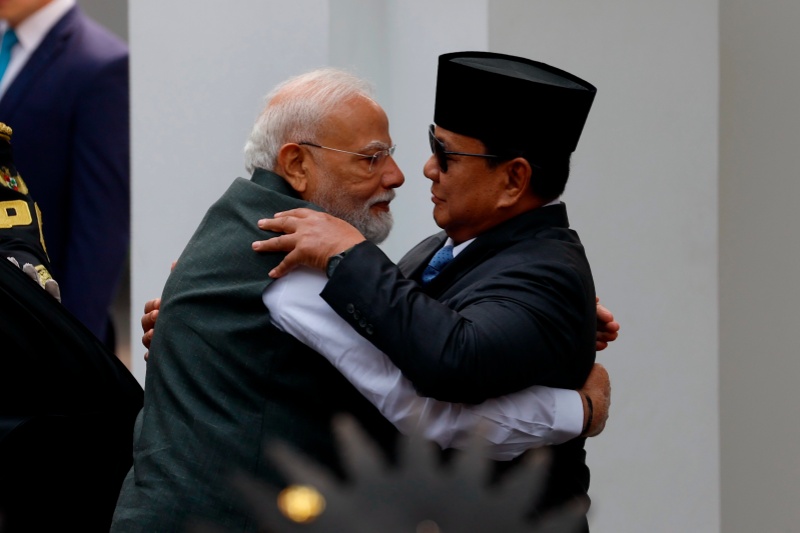
On July 7, 2026, local time, in Jakarta, Indonesia, Indian Prime Minister Modi met with Indonesian President Prabowo. IC Photo
India and Indonesia have long had a relationship based on trade and commercial cooperation. However, after establishing a "Comprehensive Strategic Partnership" in 2018, cooperation between the two countries in areas such as defense, security, and technology has deepened.
Modi’s visit this time is a response to last year’s visit by Indonesian President Prabowo Subianto to India. During his stay in Indonesia, Modi and Prabowo signed more than a dozen agreements, including those related to defense cooperation, covering key minerals, agriculture, and missile procurement.
According to reports, India will supply Indonesia with supersonic cruise missiles such as the BrahMos and air-to-air missiles like the Astra. However, the specific procurement amounts and quantities have not been announced.
The “BrahMos” supersonic cruise missile is jointly developed by India and Russia. It has a flight speed of 2.8 to 3 Mach and can carry conventional warheads weighing between 200 and 300 kilograms. It can be launched from various platforms, including land-based, sea-based, and air-based systems.
This transaction also makes Indonesia the third ASEAN country to purchase the BrahMos cruise missile, following the Philippines and Vietnam.
"Astra" is an over-the-top air-to-air missile developed by the Indian Defence Research and Development Organization. Indonesia is the first overseas customer for this missile system.
New Delhi-based researcher Dinakar Peri from the Carnegie Indo-Pacific Security Studies Project said, "Indonesia becoming the first market for the Astra missile indicates India's breakthrough in a competitive and specialized field. This helps New Delhi position itself as an important defense exporter and opens the door to exporting defense products to a wider ASEAN market in the future."
"India's choice of partners is clearly targeted," said Lin Minwang. This can be seen from the sale of "BrahMos" cruise missiles. Indonesia, Philippines, and Vietnam are all parties involved in the South China Sea disputes, India aims to enhance the capacity and willingness of these countries to engage with China in a competitive manner. In supporting them behind the scenes, India adds impetus."
In Australia, India and Australia reached an agreement on uranium exports on July 9th, after a delay of 12 years. Australia will export uranium ore to India for use in its nuclear energy industry. Both parties also agreed to deepen cooperation in areas such as renewable energy, critical minerals, and green hydrogen.
India and Australia signed a cooperation agreement on civilian nuclear energy in 2014. However, the actual export of uranium has been restricted due to concerns about nuclear proliferation. Australia is worried that uranium might be used for India's nuclear weapons program.
On the 9th, the Indian Ministry of Foreign Affairs stated that the uranium purchased from Australia will be used solely for 'peaceful purposes'.
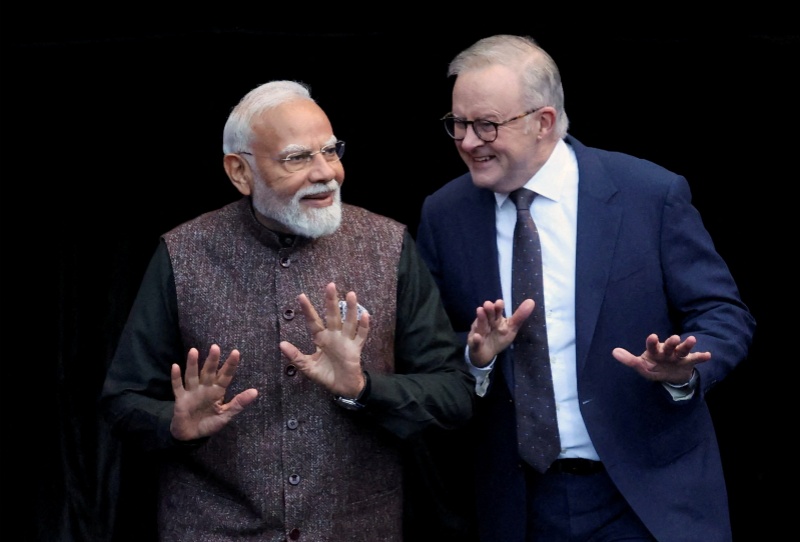
On July 10, 2026, local time, in Melbourne, Australia, Australian Prime Minister Albenes and Indian Prime Minister Modi visited the Melbourne Stadium. IC Photo
Meanwhile, defense cooperation between India and Australia continues to grow. The joint statement between the two countries mentions the need to strengthen maritime cooperation through the 'Indian-Australian Maritime Security Cooperation Roadmap', and also reaffirms their common commitment to what is called the 'peaceful and prosperous Indo-Pacific region'.
Australian Prime Minister Albornes referred to India as a "top security partner" during a joint press conference on the 9th. "Through this new and landmark agreement, we are expanding our bilateral relations to areas such as defense and security, education, science and technology, as well as energy security and critical minerals," he said.
Lin Minwang said that India used to have poor relations with Australia and New Zealand. During the Cold War, India had closer ties with the Soviet Union, while having cold and friction-filled relations with the Western bloc led by the United States.
He further pointed out that many of India's policies do not meet the expectations of the United States and the West. After India conducted a nuclear test in 1998, Australia reacted particularly strongly, even cutting off military ties with India. Although New Zealand does not take a leading role like Australia, as an important member of the “G5 War Room,” it is basically hostile towards India's policies as well.
It wasn't until 2001, when the Bush administration came to power, that relations between India and the United States began to improve. Relations with Australia and New Zealand naturally also started to improve. In November 2014, Modi visited Australia, marking the first visit by an Indian Prime Minister in 28 years.
As for New Zealand, Lin Minwang said that due to its small size and relatively low strategic importance, Modi visited New Zealand only this year. It was the first time in 40 years that India’s Prime Minister had visited that country.
In April this year, India and New Zealand signed a free trade agreement. New Zealand lifted tariffs on all of India’s exported goods, while India reduced tariffs on 95% of New Zealand’s products.
Recently, Modi has been active in the field of diplomacy.
Before visiting the three Asian-Pacific countries, Modi received a meeting with Japan's Prime Minister Shinzo Abe. Both sides confirmed cooperation in five areas, including semiconductors and critical minerals, and announced approximately 130 cooperation documents between Japanese and Indian companies, involving investments totaling about 2 trillion yen. At the joint press conference, the two further displayed a "brotherly" relationship.
The website of the magazine Foreign Policy commented that Australia and Japan are among India's closest partners in the Indo-Pacific region. Modi's contact with these two countries is an opportunity for him to strengthen cooperation in order to counter China. Although relations between China and India have recently improved, India still regards China as its greatest strategic threat.
Lin Minwang said that although India has shown relative restraint in its public statements, often putting America front and center, in reality, India has been active in the Indo-Pacific strategy and efforts to contain China.
He mentioned that in 2024, Eric Garcetti, the then US Ambassador to India, described India as sitting in the 'driving seat' of the 'Quad Security Dialogue', taking a 'leading role', while the United States was seated in the co-pilot's seat, responsible for 'correcting the steering wheel'.
The impressive diplomatic shows cannot conceal New Delhi's anxiety about the "Trump 2.0 era".
While India, Japan, and Australia continue to emphasize the so-called “free and open Indo-Pacific region,” the United States, as the initiator of the “Indo-Pacific Strategy,” has become increasingly cautious in its approach to this region.
As the core component of the “Indo-Pacific Strategy”, the “Quad Security Dialogue” has not held a summit at the presidential level for nearly two years since September 2024.
Although a meeting of foreign ministers for the “Quad Security Dialogue” was held in New Delhi in May this year, the US Department of Defense promptly announced that the US military command in the Indo-Pacific region, which was renamed in 2018, would revert to its original name: the US Pacific Command.
Although the US side emphasizes that the responsibility area of this command remains unchanged, it extends from the waters along the western coast of the US to the western border of India. However, there is a lot of speculation about this.
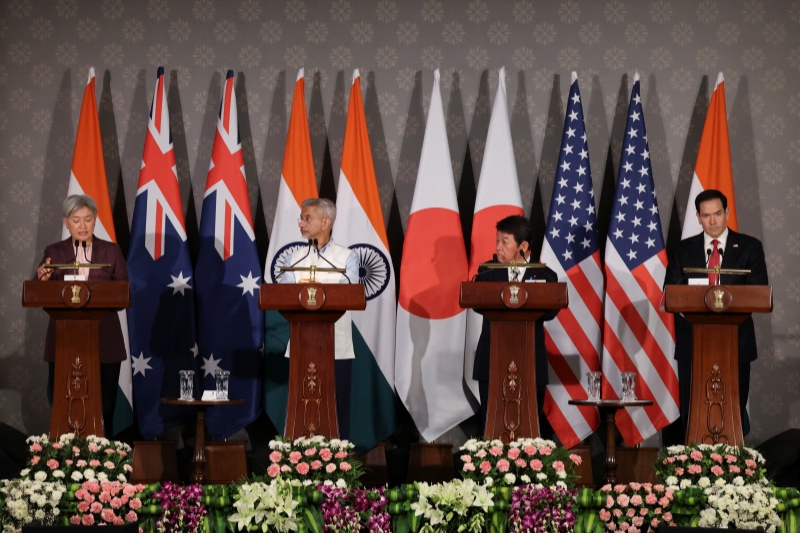
On local time May 26th, 2026, the "Foreign Ministers' Dialogue on Security" meeting was held in New Delhi. IC Photo
Bloomberg reports that this move by the US occurred after the US president's visit to China, and is widely seen as a signal that the US is reducing its focus on the Indo-Pacific region, while giving China more strategic space.
Since Trump started his second term, his priorities have fundamentally changed compared to his first term. Relations between India and the United States have continued to deteriorate due to a series of disputes, including tariff disputes, conflicts between India and Pakistan, and energy trade between India and Russia.
Lin Minwang said that, against this background, especially given the possibility of fundamental changes in Sino-US relations, India seems to be seriously considering ways to mitigate strategic risks.
On one hand, it is about improving relations with China and Pakistan. On the other hand, India is strengthening its strategic ties with American allies, creating an 'outcast alliance' that is disillusioned with Trump's policies. Since 2025, India has increased its interactions with European countries, Canada, South Korea, Japan, Australia, the Philippines, the UAE, Israel, and other major powers, with the aim of reducing its excessive strategic dependence on Washington.
"India must simultaneously take steps towards "de-Chinaization" and "de-Americanization" in both foreign affairs and strategic areas."
Lin Minwang said that the phenomenon of 'de-Sinicization' is due to India's own strategic 'internal demons' that it tries to suppress. As for 'de-Americanization', this is because the United States is the biggest external force that undermines India's sustainable development. Whether in economic and trade matters, energy supply, or the surrounding environment of India, the policies and actions of the United States have had a significant negative impact on India's geopolitical and geo-economic situations.