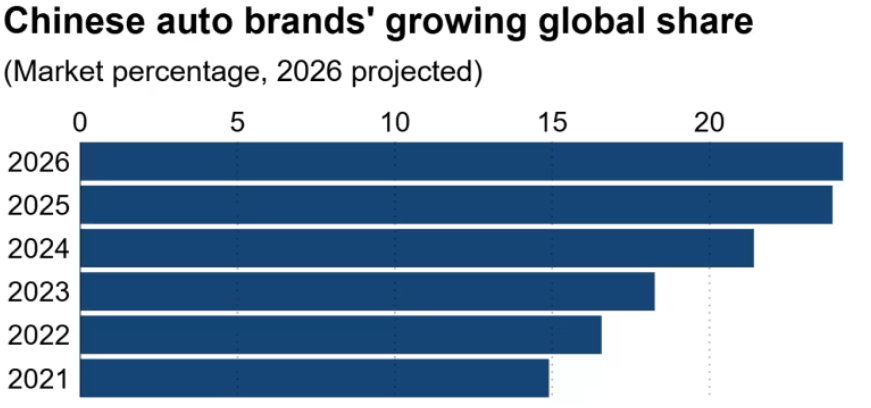
Facing the competitive pressure brought by Chinese electric vehicles, the EU attempts to support its domestic automotive industry by raising localization requirements. However, relevant policies have not yet been implemented, and divisions within the EU’s automotive industry have already begun to emerge.
According to a report by European News Network on July 2nd, the European Commission is promoting the ‘Made in Europe’ strategy, developing the so-called ‘Industrial Accelerator Act’. The plan is to prioritize support for electric vehicles that use European components in public procurement and subsidies, in order to enhance the competitiveness of the EU automotive industry and counter competition from Chinese companies.
According to the current proposed scheme, electric vehicles must meet a requirement of 70% localization. However, this standard has sparked controversy among EU auto suppliers and vehicle manufacturers.

ID.3 electric car on the assembly line at Volkswagen's German factory. Financial Times
The European Car Parts Industry Association (CLEPA), representing automotive component manufacturers, believes that the proposal from the European Commission is a step in the right direction. According to a study commissioned by management consulting firm Roland Berger and reviewed by Euronews, the proportion of European-made components in plug-in hybrid and electric vehicles produced in Europe has reached 80% to 90%.
Therefore, the European Automotive Suppliers' Association believes that the 70% localization threshold proposed by the committee is entirely feasible to achieve.
However, the Association of European Car Manufacturers (ACEA), which represents entire vehicle companies, advocates using a different method of calculation. It is recommended that regulatory agencies assess the European value added of the entire vehicle, rather than simply counting the percentage of local components in the vehicle.
The European Automobile Manufacturers Association stated in a position paper released on July 1st: "The value of a car is not merely the sum of its components. Its value also lies in its research and development, advanced engineering technology, and the highly skilled workforce behind it."
In response to this, the European Automobile Manufacturers Association stated that if the method proposed by the European Automobile Manufacturers Association is adopted, only about 50% of the components need to be manufactured within the EU, with the remaining 20% of components being possible to be sourced through research and development, design, and other processes.
European Automobile Manufacturers Association warns that this amounts to a 20 percent dilution of the EU’s requirements for manufactured parts, “which could lead to the loss of 350,000 jobs.” The association believes that the European Commission’s approach of calculating localization percentages based on parts is more conducive to “maintaining the existing manufacturing base.”
"Currently, we are facing fierce competition from low-cost countries, and the real 'elephant in the room' is China. European Automotive Suppliers Association Secretary General Benjamin Krieger told European News Network."
He said, “If the ‘made in Europe’ standard ignores where the components are produced, then this label also ignores the interests of European workers.”
In recent years, as the competitiveness of China's new energy vehicles has continued to rise, the European Union has been tightening its industrial policies regarding the automotive industry.
In March of this year, the EU issued a "Motor Industry Action Plan," which proposes to prioritize support for European domestic enterprises in areas such as public procurement, power batteries, key raw materials, and charging infrastructure. It also aims to promote the establishment of "European manufacturing" standards. The "Industrial Accelerator Act" is an important part of this series of industrial policies. Its core objective is to increase the weight of European domestic manufacturing in government procurement and financial subsidies.
Regarding the series of restrictions imposed by the EU on Chinese electric vehicles, the Chinese side has repeatedly opposed them.
The Ministry of Commerce previously stated that the development advantages of China's new energy vehicle industry stem from continuous technological innovation, a well-established industrial chain and supply chain, as well as full market competition, rather than so-called government subsidies. The European side's restrictions on Chinese enterprises on the grounds of anti-subsidy investigations and increased tariffs not only violate WTO rules but also disrupt the stability of the global automotive industry supply chain, ultimately harming the interests of all parties, including European consumers and enterprises.